
We previously published comparisons of the North American and European Payment Facilitators (“PayFac”) ecosystem in 2023 and 2024; we have revisited the registries to see what has changed…
1. Evolution of Registered PayFacs
(total number of PayFacs in the US & Canada and Europe1, as of Sep 2026)
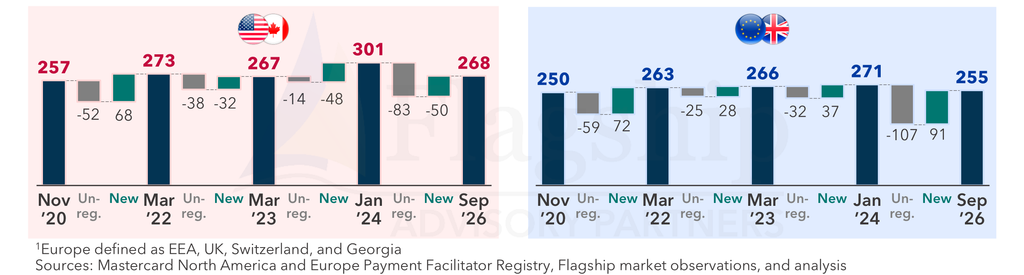
- After several years of growth, registered PayFac counts recently declined: both registries peaked in 2024 and have since fallen by 11% in North America and 6% in Europe/UK
- The market remains active, but is consolidating as M&A, exits and de-registrations have offset new registrations. Expansion of Managed PayFac operating model (aka PayFac Lite) contributing to slowdown in the full, Registered PayFac model
2. Software PayFacs Growth
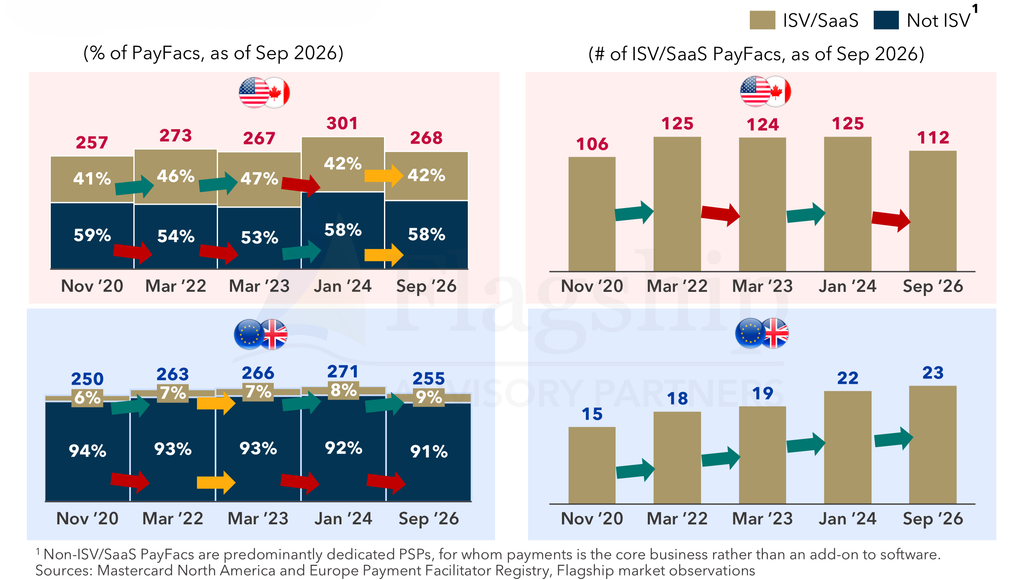
- Software Registered Payfacs peaked in 2024 in North America, now a declining trend
- Prominence of Software Registered PayFacs growing steadily in Europe as leading global SaaS companies expand their preferred, higher-control operating model to the continent.
3. Registered ISV/SaaS PayFacs By Vertical
(# of total ISV/SaaS PayFacs, as of Sep 2026)
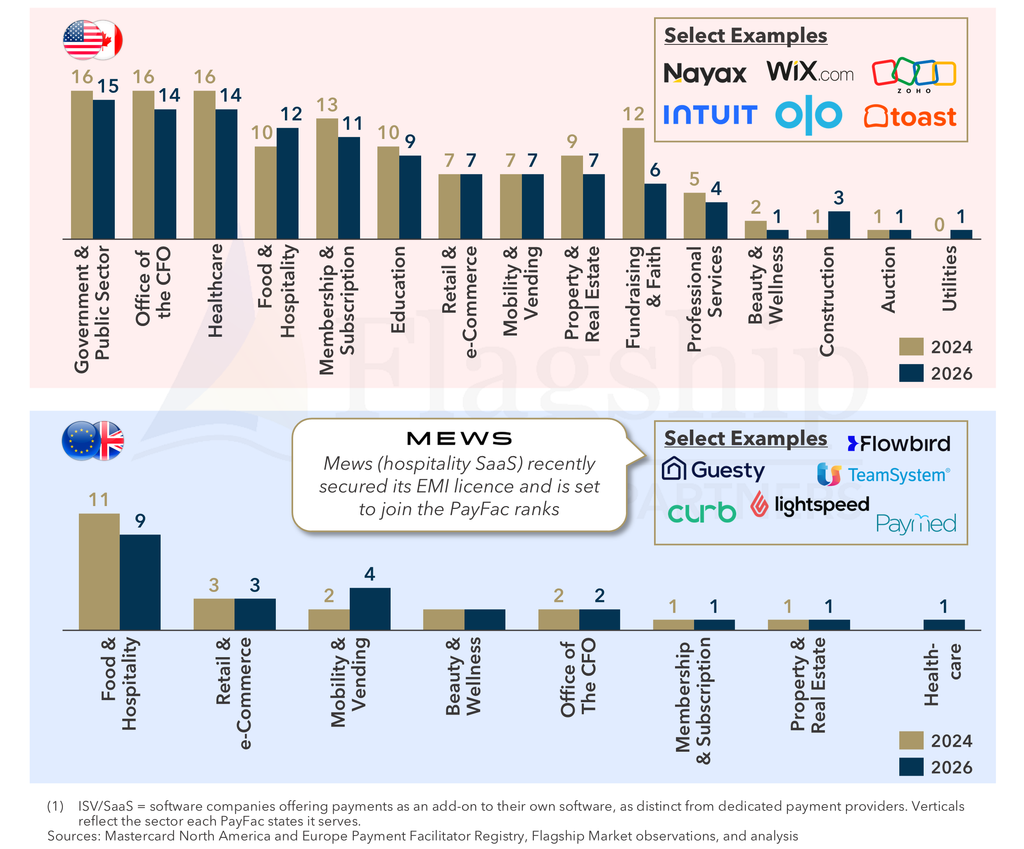
- In North America, the Registered PayFac operating model can be seen across software verticals, with Government, Office of the CFO, Healthcare, Food & Hospitality, Membership & Subscription, Education, Fundraising and Membership all at meaningful scale.
- Europe is earlier in the adoption curve of Registered PayFac model, but usage of the model is growing slowly (Europe accounting for 8 of the 20 new ISV registrations across regions, despite being a notably smaller software region). European registered payments are concentrated within Food & Hospitality, the vertical accounting for ~40% of European Registered PayFac ISVs
- Registered PayFac ISVs are less common in Europe due to higher regulatory burden (Payment Institution or Electronic Money Institution License required) and smaller scale of ISVs. European ISVs more commonly operate under Managed PayFac-lite model.
4. Integrated/Embedded Payments Operating Model Spectrum for ISV/SaaS
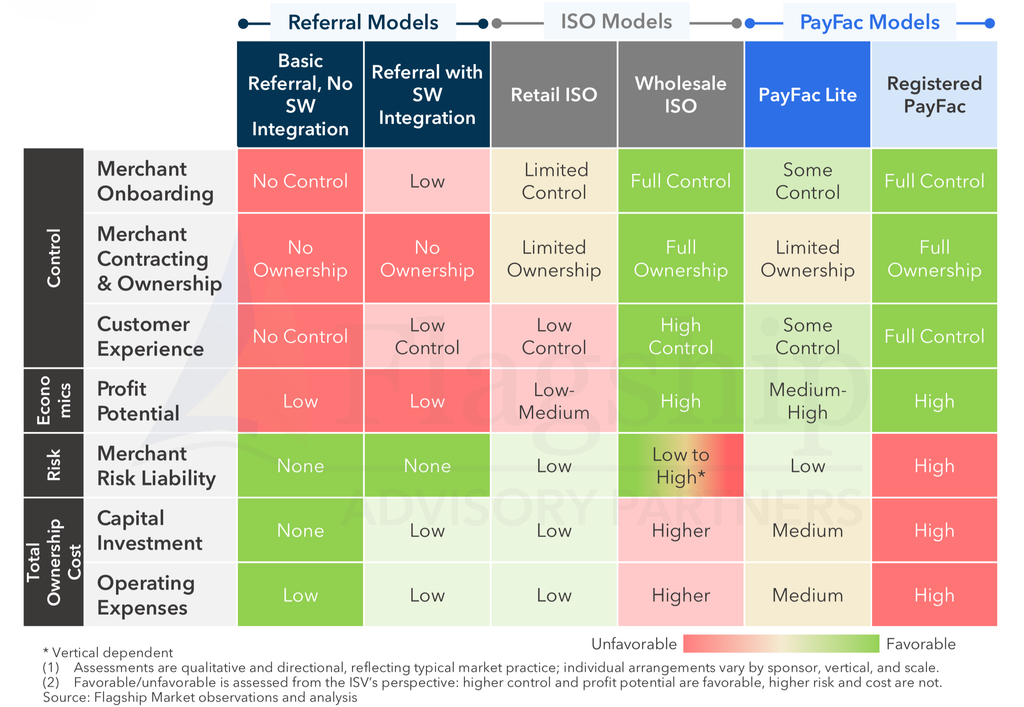
- The PayFac journey is an evolution, not a binary decision. ISVs do not leapfrog directly into the custom-built PayFac bucket. Having said that, we are observing that ISVs are increasingly moving toward forms of PayFac models to capture more of the economics and own more of the merchant experience.
- Ownership of embedded finance is seen as an important defensive moat vs. potential AI disruption across the software industry.
- The spectrum in operating models, however, reflects a clear trade-off between control and economics versus cost, risk, and complexity.
- Referral models require the least investment but offer limited control, while ISO and hybrid PayFac models provide progressively greater ownership of merchants and the customer experience.
- Managed PayFac, where most scaled ISVs sit today, provides a branded payments experience and improved economics without the full regulatory and operational burden of registration, while preserving a natural path to full PayFac status once branded volumes reach sufficient scale
- Registered PayFac offers the highest level of control and monetization potential, but also the greatest investment, risk, and operational complexity
- Referral models require the least investment but offer limited control, while ISO and hybrid PayFac models provide progressively greater ownership of merchants and the customer experience.
- Payments are only the starting point for monetizing embedded finance. Greater control over the merchant relationship, onboarding, transaction flows, and payment data creates the foundation for a broader embedded finance strategy, enabling ISVs to add lending, cards, accounts, payouts, and treasury services over time
Please do not hesitate to contact Charlotte Al Usta at Charlotte@Flagshipap.com with comments or questions.