
Introduction
Bank transfers, notably ACH, are the workhorse of U.S. B2B payments, accounting for more than 60% of U.S. B2B payment volume. ACH is generally treated as a basic, low-cost means of moving money; however, a low-cost ACH payment increasingly does not entail a low-touch payment experience.
Standard ACH has limitations that can create meaningful friction for payers and payees (aka buyers and suppliers), particularly regarding remittance data, reconciliation, fraud, payment exceptions, and settlement speed. Fintechs have begun addressing these pain points by layering value-added services on top of the underlying ACH rails, creating improved experiences, outcomes, and monetization of payment flows.
Offerings marketed as “ACH+,” “Enhanced ACH,” and “Pay-by-Bank” vary in design but share a common premise: suppliers and/or buyers will pay more for bank transfers that are frictionless, low-risk, and quick. This has created an opportunity to productize value-adds on top of bank transfer rails (ACH, RTP, FedNow, etc.); a growing category of products we (Flagship) refer to as value-added bank transfers. In this article, we define the category, explain what makes a bank transfer value-added, and examine where these propositions create value for buyers, suppliers, and fintechs.
The Limitations of Standard Bank Transfers
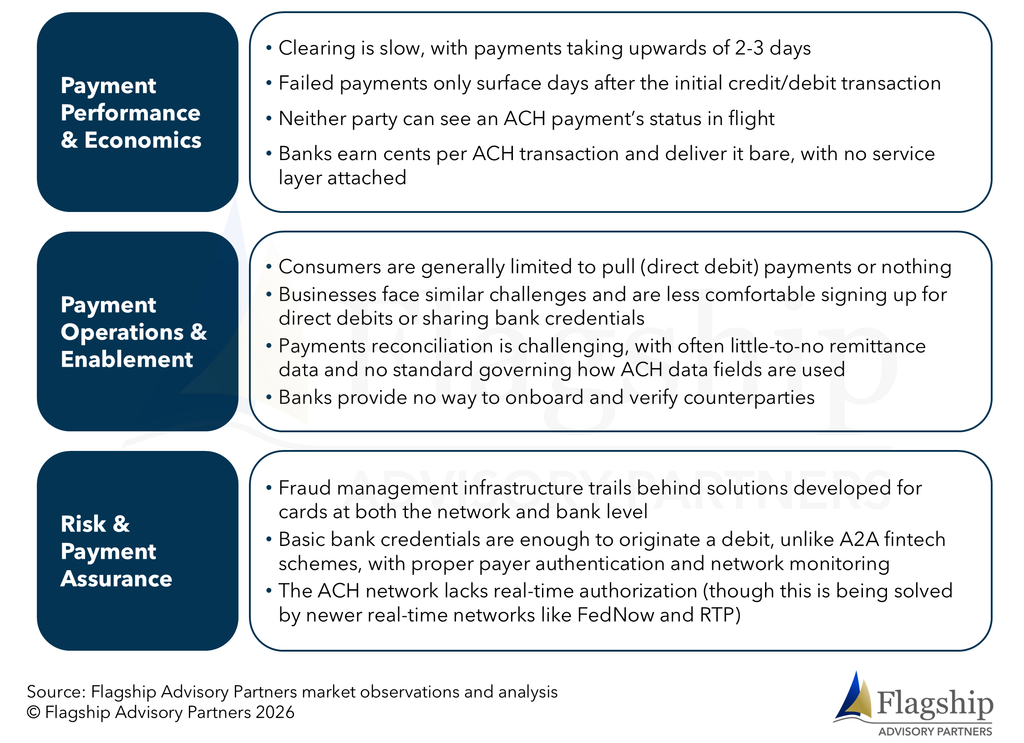
U.S. ACH payment rails were designed decades ago to move money between banks, not to solve the needs of buyer and supplier end-users. Among other pain points, a standard ACH transaction comes with little visibility into status and limited remittance information, moves slowly, and leaves buyers and suppliers responsible for managing fraud, failed payments, and exceptions.
ACH networks, operating under NACHA standards, have been upgraded over the years, but limitations on end-user features persist because banks have had little financial incentive to prioritize product innovation on these rails. Card issuing is simply too lucrative and comes with broad-based customer affinity and value-adds. Yet for B2B payments or higher-value consumer payments, card network fees have created significant limits on penetration. This is the crux of the supply-and-demand opportunity driving innovation in the form of value-added bank transfers.
In Figure 1, we outline where standard bank transfers fall short today.
Figure 1: Limitations of Standard ACH
(non-exhaustive)
What Makes a Value-Added Bank Transfer
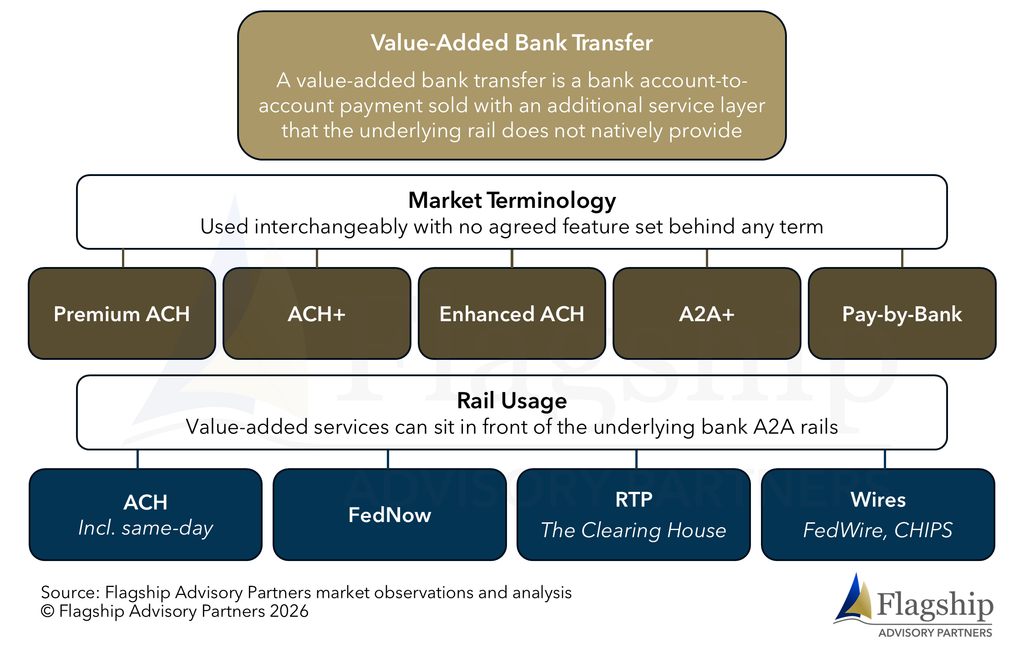
Value-added bank transfers (VABTs) combine the underlying bank payment with features that improve ease of use and transaction outcomes for payers and payees. There is no single form of VABT on the market today, rather we see many forms of value-adds that vary based on commercial context. There is also no common lexicon for how VABTs are marketed, although ACH+ is the most common product name. In Figure 2, we depict the various names for VABTs observed in the market, as well as the underlying rails that enable them, illustrating that, regardless of name, VABTs are rail-agnostic.
Figure 2: Defining Value-Added Bank Transfer
(non-exhaustive, excludes cross border payment use cases)
VABT services generally address three areas of the payment experience:
- Payment Performance & Economics: Can I improve payment success, speed, or financial outcomes?
- Payment Operations & Enablement: Can I make the end-to-end payment process easier to administer and reconcile?
- Risk & Payment Assurance: Can I trust the counterparty and safely execute the bank transfer?
In Figure 3, we further describe the various forms of value-adds powering VABT products. Note that the category is not homogeneous; forms of value-added features are broad, varied, and are often described and marketed quite differently depending on the context and targeted customers.
Figure 3: Value-Added Features Fintechs Bring to Bank Transfers
(non-exhaustive, excludes cross-border payment services)
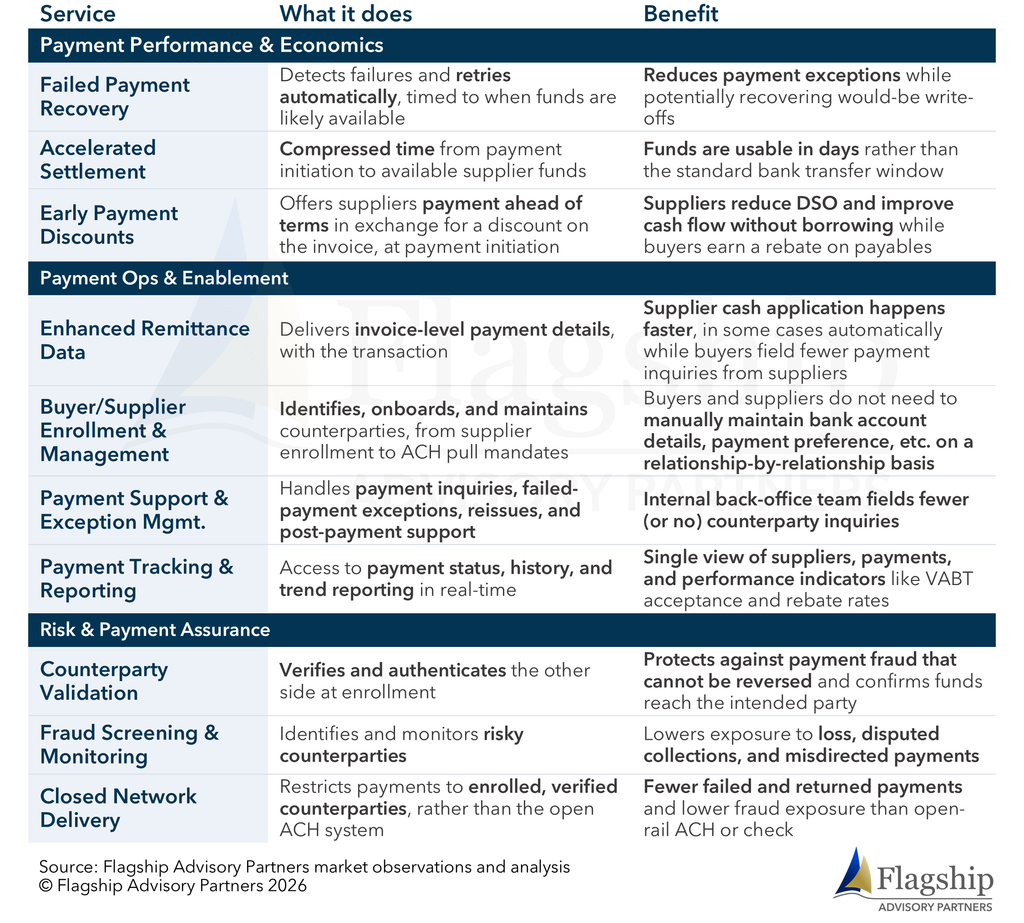
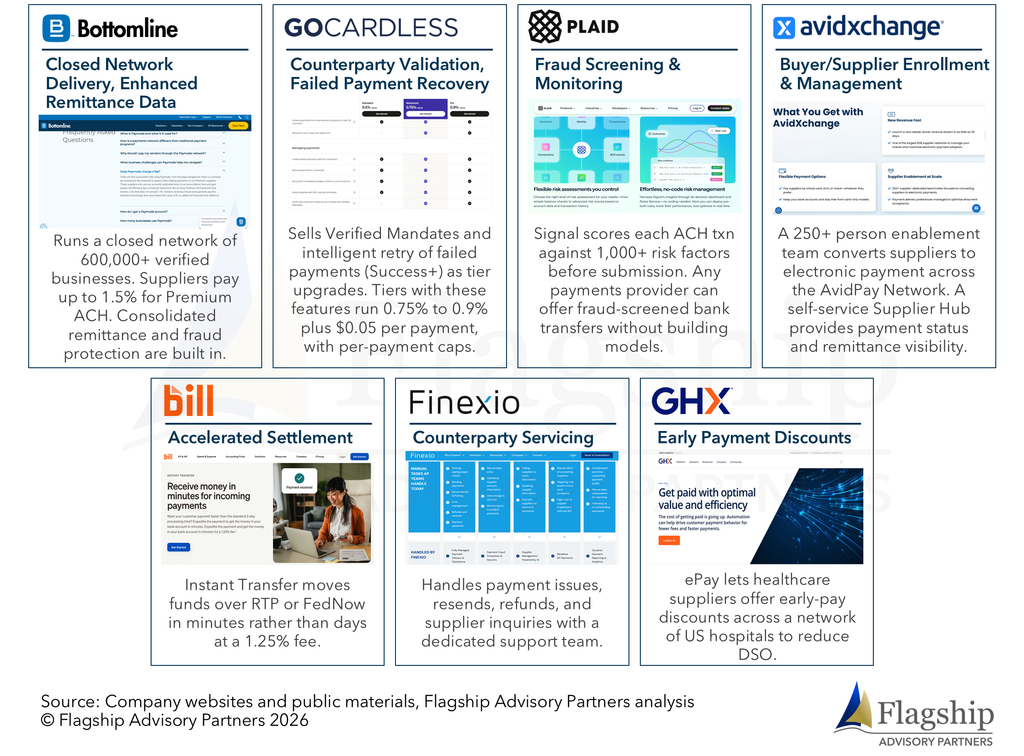
Figure 4 highlights in-market examples of VABT actively marketed today. VABTs can be either push (credit transfers) or pull payments (direct debits), with the relevant features varying by use case: supplier enrollment and remittance services naturally support credit payments, while account validation and failed payment retry/recovery are particularly relevant to debit flows.
Figure 4: Providers Delivering Value-Added Bank Transfer Services
(non-exhaustive, illustrative providers only)
It is important to note that we consider VABT to be rail-agnostic, although most forms of VABT in the U.S. today are built on ACH rails. We expect great focus on productizing and monetizing real-time payments rails (e.g., FedNow and RTP), but these networks are still building their footing with banks, fintechs, buyers, and suppliers. We have observed that to attach and monetize a VABT product, a provider needs only to effectively address one pain point; while solutions that resolve multiple areas of friction are beneficial, is not necessary to offer a comprehensive VABT package to compete in the market.
Economics of Value-Added Bank Transfers
The VABT model works because value-added features align a willingness to pay more than standard ACH with economic incentives for fintechs to develop and attach these innovations. We consider the addressable pool for VABT significant, given the $33T of U.S. B2B payments (in addition to the C2B opportunity), and highly appealing, given the large delta between the cost of card acceptance and the raw cost of bank transfer rails. The market demonstrates a strong willingness to pay for frictionless payment outcomes at costs lower than cards.
- For suppliers, standard bank payments can create meaningful indirect costs, such as manual workflows, exception management, losses, and settlement delays. Value-adds that address these indirect costs drive willingness to pay. Supplier enrollment remains a key source of friction for attaching both VABT and card acceptance. We see great value in providing a strong bundle of both cards and VABT, along with supplier/merchant controls to optimize.
- For buyers, cards are often preferred, given the rebates earned; however, card acceptance is limited. There are forms of VABT that also generate potential rebates but, in general, VABT is good for buyers because it reduces commercial friction relative to checks or traditional forms of ACH. With VABT features, buyers can be onboarded, pay more quickly and securely, and may capture discounts or the benefits of enriched data coming from the supplier.
There is a compelling economic middle ground between standard ACH and commercial cards, where payments cost more than both standard ACH and paper check (excluding the labor costs), but less than card acceptance. For fintechs and payment service providers, this creates an opportunity to earn meaningful economics on payment volumes that historically generated low single-digit basis point take rates. In Figure 5, we illustrate Flagship’s observed acceptance costs across relevant payment methods.
Figure 5: Observed Cost of Acceptance by Offering
(directional, assumes $500 transaction size)
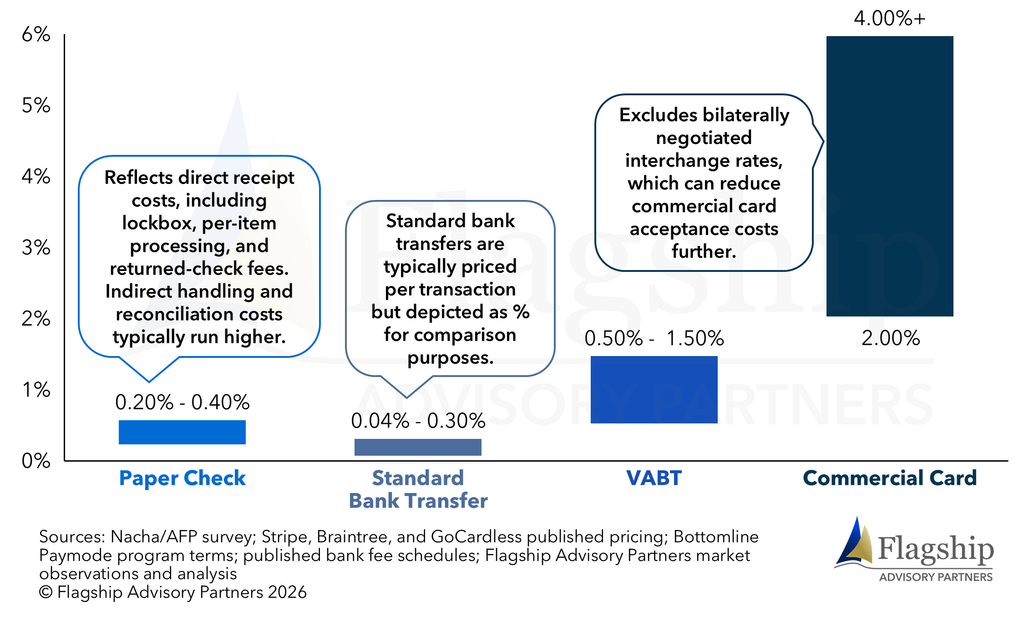
Note that the estimated costs of paper check acceptance in Figure 5 understate the true cost, as transaction fees, financial losses, labor costs, and time value of money are excluded from the calculation.
Where Value-Added Bank Transfers Work Best
The VABT opportunity is most relevant in U.S. B2B payments because bank transfers represent over 60% of payment volume (see Figure 6), with nearly 40% still on paper check.
Figure 6: Bank Transfer Prominence, B2B vs. C2B
(% of US transaction value; addressed volume in trillions, 2025)
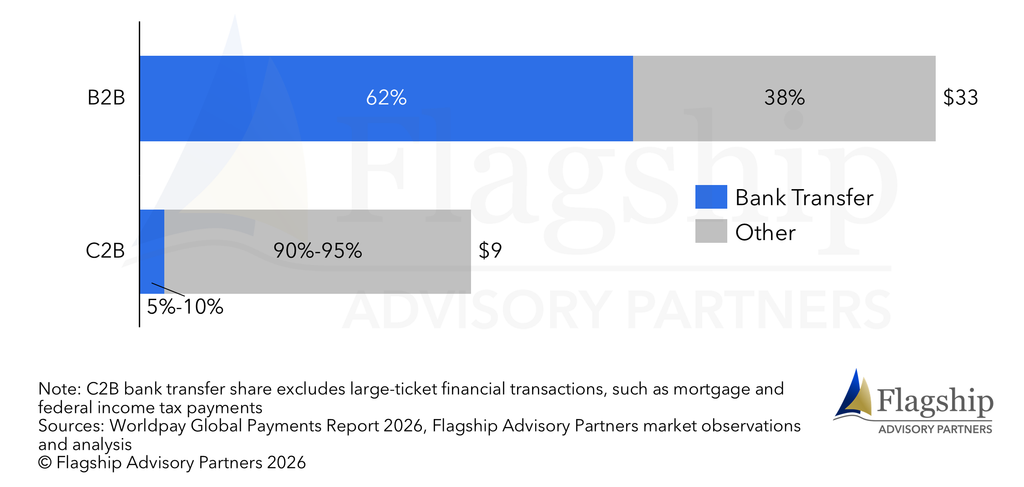
This does not mean every bank payment warrants a monetized value-added feature layer. The proposition is strongest where payment values are large, payment operations are more complex, workflows and reconciliation are most challenging, and suppliers are more sensitive to the time value of money. We observe VABTs to be most relevant in verticals such as wholesale distribution, manufacturing, construction, real estate, and insurance, among others. These industries involve relatively large invoices, established trading relationships, meaningful reconciliation requirements, and significant operational consequences when payments fail or cannot be easily identified.
Conclusion
Value-added bank transfers are a massive revenue pool opportunity in the U.S. market, where we see substantial ongoing growth powered by check displacement and persistent high cost of cards. Fintechs, particularly those focused on B2B, will be the primary beneficiaries of a well-crafted VABT product, along with the platforms working with those fintechs. We see VABT as an important complement to card acceptance (A/R) and virtual card disbursements (A/P) because VABT drives frictionless payments in areas of the market where cards are less preferred. We believe that market-leading fintechs and platforms will be among those who drive VABT innovation on both the A/P and A/R sides of B2B commerce.
Please do not hesitate to contact Rom Mascetti at Rom@Flagshipap.com with comments or questions.