
The Problem: Why Banks Lag in the SMB Segment
As a result, European banks are steadily losing share to fintechs and SaaS platforms that offer more integrated, user-friendly, and quick and easy-to-buy financial solutions.
Investment Thesis: Accounting SaaS as Distribution Channel for Banking
In mature markets (especially the US and UK), vertical SaaS has emerged as the dominant distribution model for reaching SMBs, clearly surpassing banks in e-commerce payments acceptance, and gaining ground rapidly at the physical point-of-sale.
Continental Europe remains at an earlier stage of this evolution, largely due to its geographic fragmentation and the smaller scale of its domestic SaaS platforms. However, the structural logic remains compelling, and the same transformation will inevitably unfold.
Within this landscape, accounting SaaS stands out as the backbone of SMB financial management, as it is the hub through which nearly all financial data flows, making accounting SaaS the ideal anchor for embedded financial services.
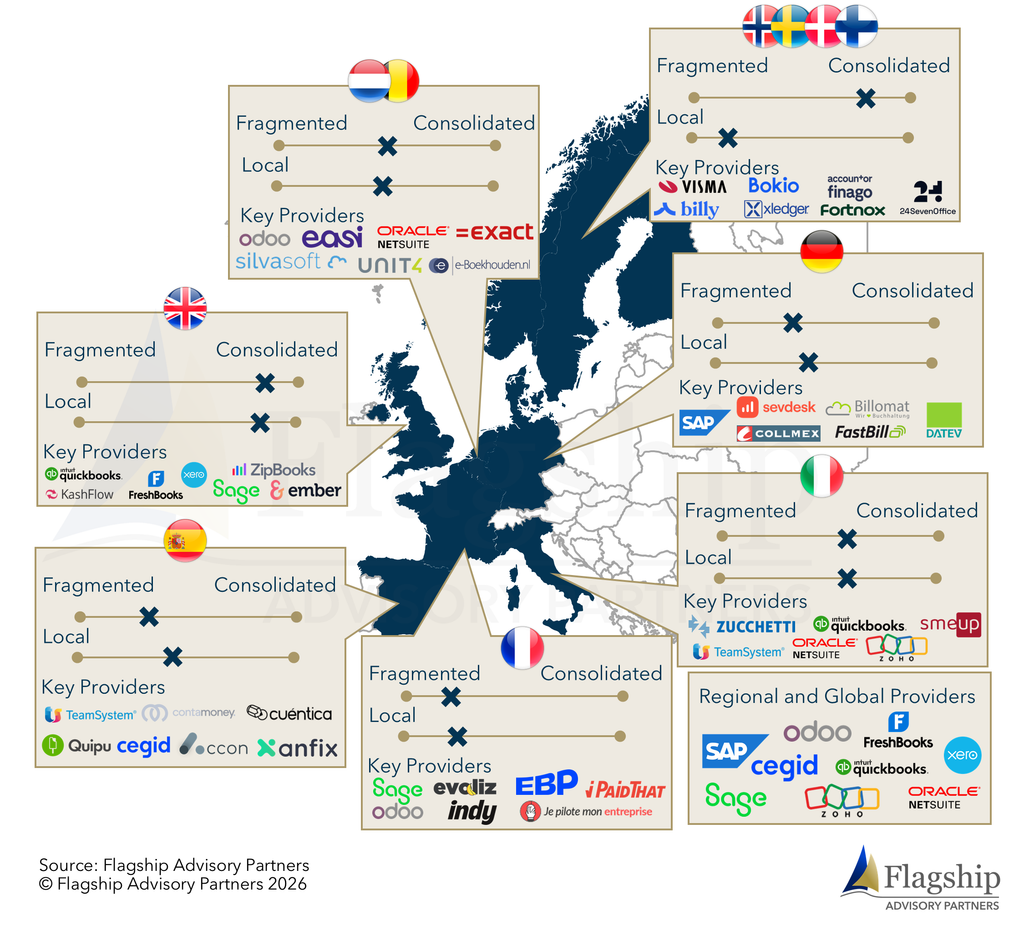
The European accounting SaaS market is fragmented, localized, and served by relatively small software providers. However, most European countries have three to four sizable providers with meaningful market share in the country, as Figure 1 shows.
Figure 1: Accounting Platform Landscape in Europe
(non-exhaustive; analysis of 100+ providers; SME focus)
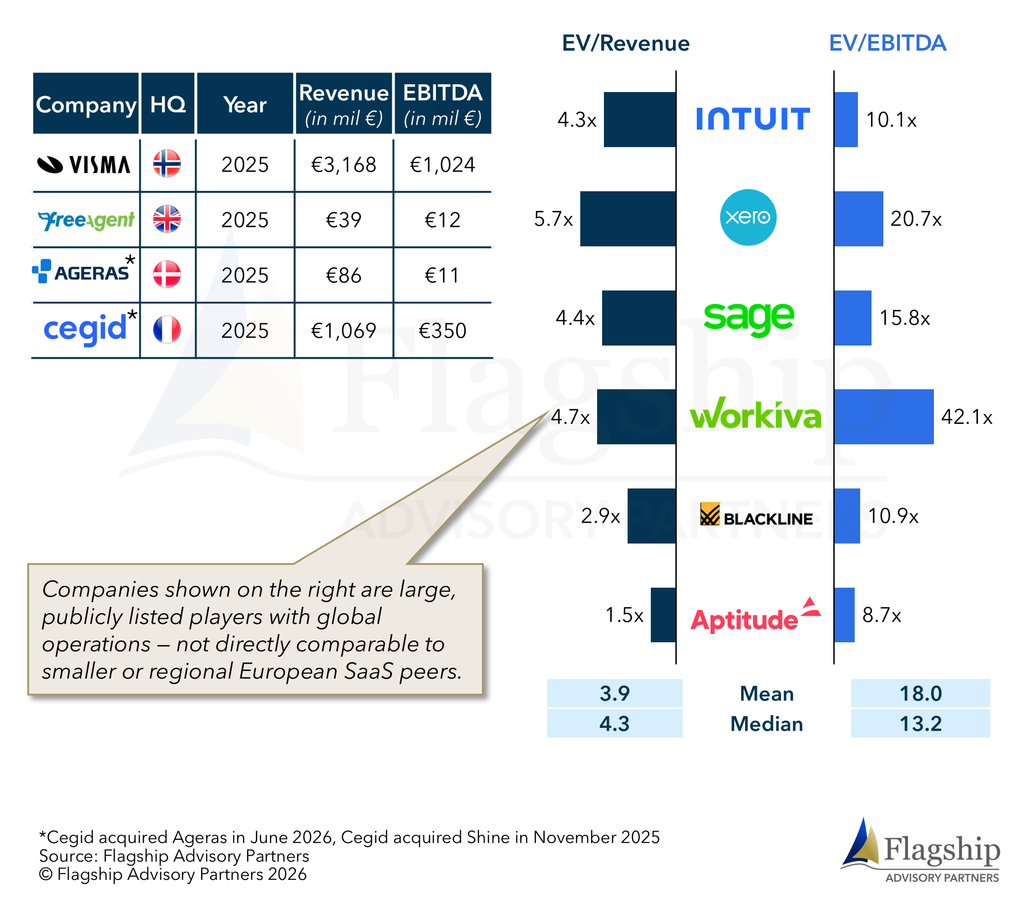
Valuations of European accounting SaaS companies are reasonable, given the limited pool of local buyers and the domestic nature of most platforms. This dynamic creates an attractive entry point for banks seeking to grow in the domestic SMB ecosystem. As Figure 2 suggests, larger and more global SaaS platforms currently trade at median revenue multiples of 4.3x. In contrast, we expect smaller, local European accounting SaaS providers to be valued below this range, offering meaningful potential for value creation.
Figure 2: Office of the CFO Deal Multiples
(select companies and transactions; mean and median over sample; as of 8 Sept 2026)
By acquiring (or partnering with) a leading domestic accounting SaaS provider, a bank could instantly gain preferential access to a large share of the SMB market and achieve several critical objectives:
- Get a jump on competitors by positioning earlier in the new SMB lifecycle, as SMBs often buy software before bank accounts (or start with a “lite” bank account to get up and running before shopping around for a “full service” bank account);
- Obtaining a powerful channel with which to reach customers and potentially convert them to primary banking;
- Obtain relevant touchpoints to sell high-margin “point” products: payment acceptance, commercial cards, cross-border and FX, working capital, etc.
- Create a compelling and differentiated value proposition (integrated financial services within the workflows of the software save huge amounts of time for the SMB);
- Create a strong and differentiated hook to drive new customer acquisition vs. competitors; and
- Obtain a huge base of data that can improve underwriting models, marketing targeting, etc.
The Opportunity: Building an Embedded Banking and Accounting Ecosystem
A bank’s acquisition of or partnership with an accounting SaaS provider creates mutually reinforcing value on both sides of the deal.
Embedding banking products into accounting SaaS drives new customer acquisition, improves retention, and solves key SMB pain points. The accounting platform then becomes a powerful distribution channel for a broad suite of financial products, enhancing its functionality and user experience and making it a more indispensable daily tool for SMBs.
Figure 3: Embedded Finance Proposition Opportunity for Banks
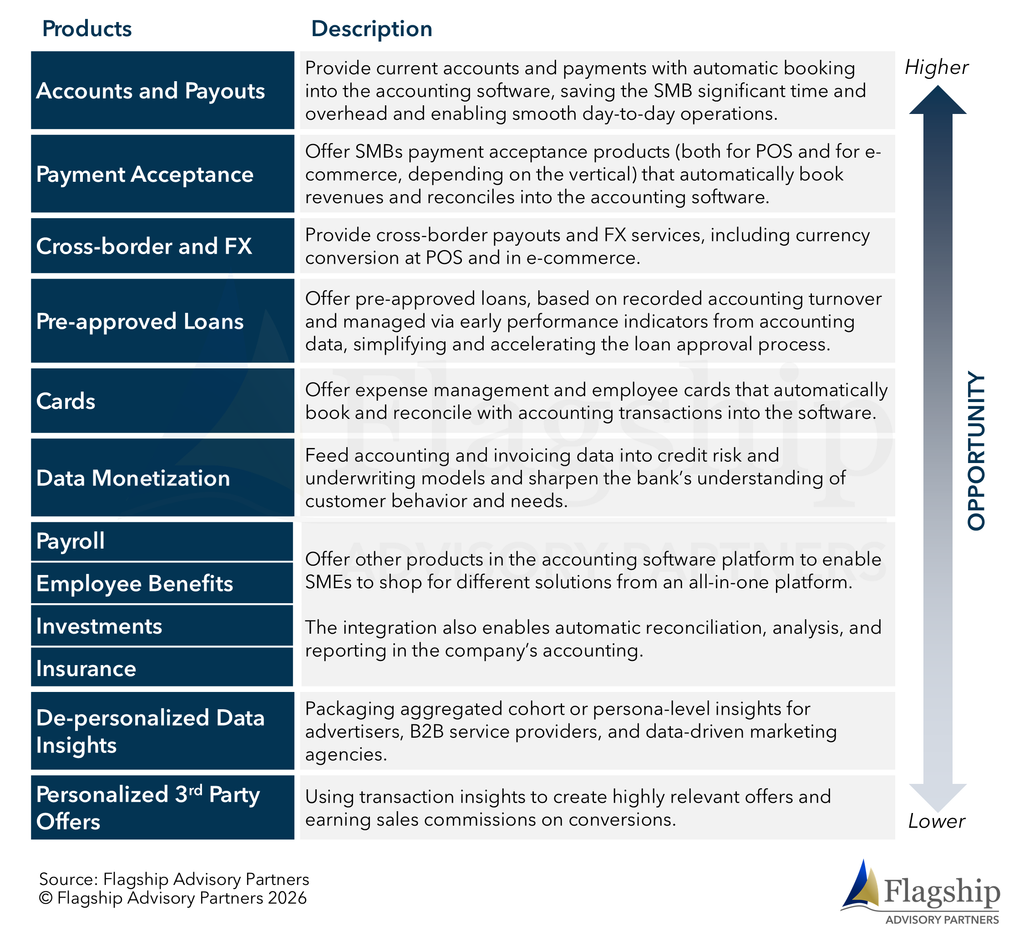
With proper safeguards and compliance in place, the combined banking and accounting data can generate new monetization opportunities, as described in Figure 3. Together, these initiatives create a powerful, symbiotic ecosystem: the bank enhances its SMB reach and value proposition, while the accounting SaaS platform gains new growth vectors and monetization.
Why Buy Rather Than Partner
Banks can pursue distribution partnerships with accounting platforms instead of acquisitions, and many have. Ownership is the better answer wherever a bank intends to make embedded SMB finance core to its strategy rather than a side experiment. Acquiring an accounting platform gives the bank control over its own destiny, instead of dependence on a partner’s roadmap and commercial priorities. While an acquisition demands real executive commitment and smart execution, it gives the bank the ability to enact the changes it needs to drive results on its own timetable and needs rather than through negotiation. Moreover, compared to the bank’s large scale, the deal size of acquiring a domestic accounting software provider is likely to be relatively small and digestible. The core of the investment thesis is therefore: for a (relatively) small outlay, assuming the bank can act boldly, it acquires a new channel and capabilities that transform it from an (arguably) undifferentiated utility to a front-and-center provider to the SMB, thereby giving the bank a much better position to acquire and retain customers.
Please do not hesitate to contact Erik Howell at Erik@Flagshipap.com and Emilia Cavallini at Emilia@Flagshipap.com with comments or questions.