
Those who think of Europe’s B2B e-invoicing mandates as just a tax-compliance software upgrade have clearly gotten it wrong. Beyond the compliance burden, these mandates unlock a larger commercial opportunity: making structured, machine-readable transaction data ubiquitous and cost-effective to access. This data layer is also the missing precondition for two propositions that have been stuck at the margins of European B2B payments for decades: commercial card acceptance on the supplier side, and fintech-led working-capital financing embedded in CFO office platforms. We expect both to break through in the foreseeable future.
In this article, we look at the in-flight and upcoming B2B e-invoicing regulations and explore the fintech opportunities they unlock.
A Regulatory Reform That Is Quietly a Payments Reform
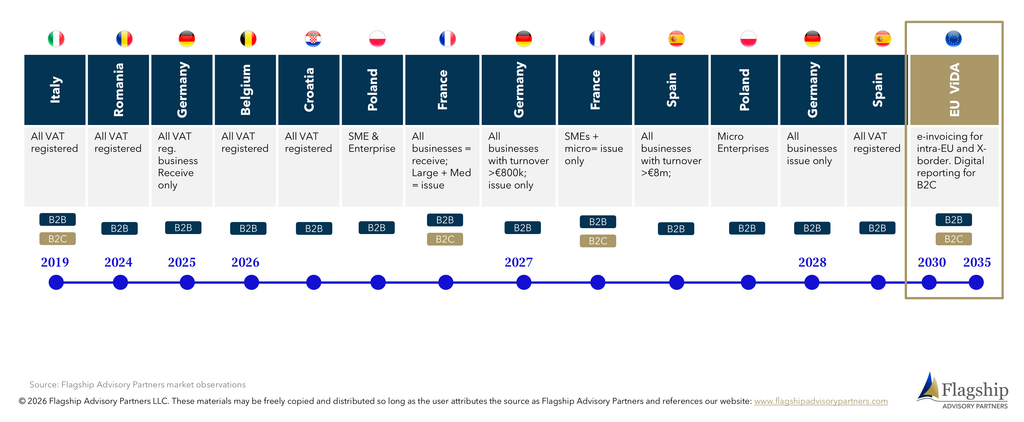
The European invoice is being digitized, and key regulations are underway. ViDA (VAT in the Digital Age) entered into force with mandatory e-invoicing and near-real-time digital reporting for intra-EU B2B transactions (applicable from July 2030). National B2B e-invoicing mandates are well underway, dematerializing paper invoices and standardizing the e-invoice format and transportation interface (see Figure 1). For example, Belgium went live with mandatory domestic B2B structured e-invoicing on 1 January 2026. Poland’s KSeF clearance model captured large taxpayers on 1 February 2026 and essentially everyone else on 1 April 2026. France begins its phased rollout on 1 September 2026.
Figure 1: European B2B E-Invoicing Mandate Timeline, 2025-2030
(select markets)
Meta boxes
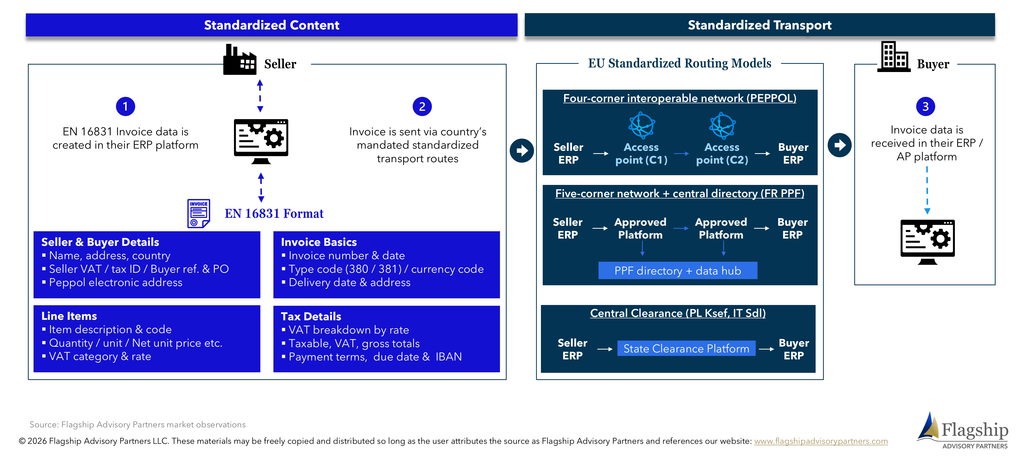
These regulations standardize both the content and the transport of every B2B invoice simultaneously, as illustrated in Figure 2:
- Standardized content. EN 16931 (a common, machine-readable data model built for B2B invoicing and digital tax reporting) gives every in-scope invoice the same structure, including line-item detail: item description, quantity, unit of measure, net price, and VAT treatment.
- Standardized transport. Peppol Access Points (a secure, standardized global network framework used by businesses and governments to exchange electronic documents like invoices) and national invoicing gateways (such as France’s Approved Platforms and Poland’s KSeF) mean that invoice data no longer sits locked inside individual ERPs or procurement portals. It moves through interoperable network endpoints with published directories so that any invoice can be routed to a known address.
Figure 2: Standardized Content and Transport in B2B E-Invoicing
The invoice, historically in paper form or as a PDF emailed to an accounts payable inbox, therefore becomes a machine-readable object with a routing address on essentially every B2B transaction in Europe. The friction that has kept cards and third-party financing out of the invoice-to-cash cycle is being engineered to an extent out by regulations, and the structured rails that acquirers and lenders would otherwise have had to build themselves are arriving as a regulatory by-product rather than as a build cost.
We see clear opportunities for acceleration in B2B payments due to these regulations, most prevalent in commercial card acceptance and B2B embedded lending.
The Commercial Card Acceptance Opportunity
Commercial cards remain a thin slice of European B2B flows, at under 3% of B2B payment value today. The binding constraint has been supplier-side acceptance. Buyers like cards for the longer payment terms, rebates, spend controls, and consolidated data. The constraint is supplier card acceptance cost, and in Europe, that cost is structurally high because the alternative is offline bank A2A transfers, often priced at a few cents or offered free. A supplier asked to accept a card on a €40,000 invoice is being asked to give up €500 to €1,000 of margin. Most decline, surcharge, or quietly steer the buyer to a bank transfer.
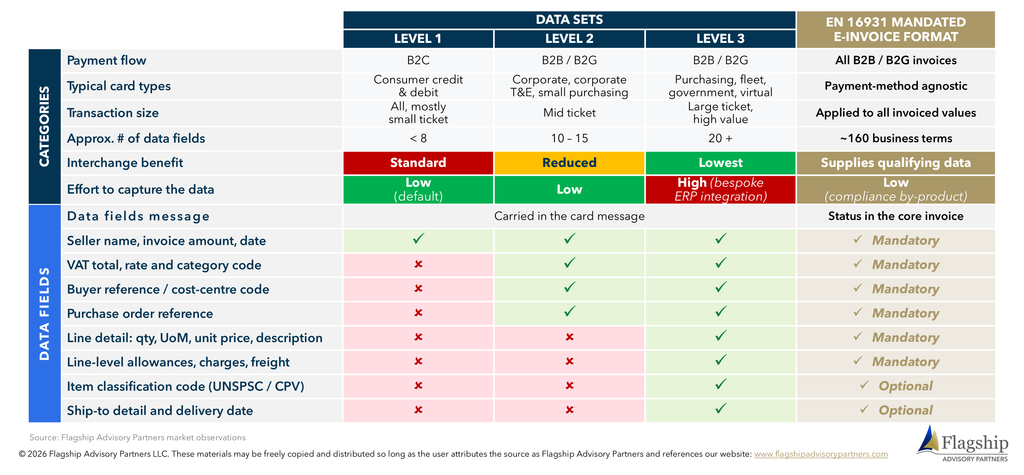
Crucially, the acceptance rebates in commercial card acceptance are data-dependent. Enhanced remittance and line-item data qualify a transaction for lower interchange rates, and in the US, upgrading to Level 2/3 can save on the order of 1–2% compared to standard commercial rates. Historically, capturing that data at the point of acceptance was the hard part, as acquirers had to build tighter, often time-consuming integrations with ERPs to extract the right data feeds. The e-invoicing mandates now produce these data feeds as a by-product of compliance (see Figure 3), thereby making it relatively less cumbersome for acquirers to build these feeds: the enhanced dataset exists for every invoice, whether or not a card is used.
Figure 3: The Level 2/3 Data Opportunity
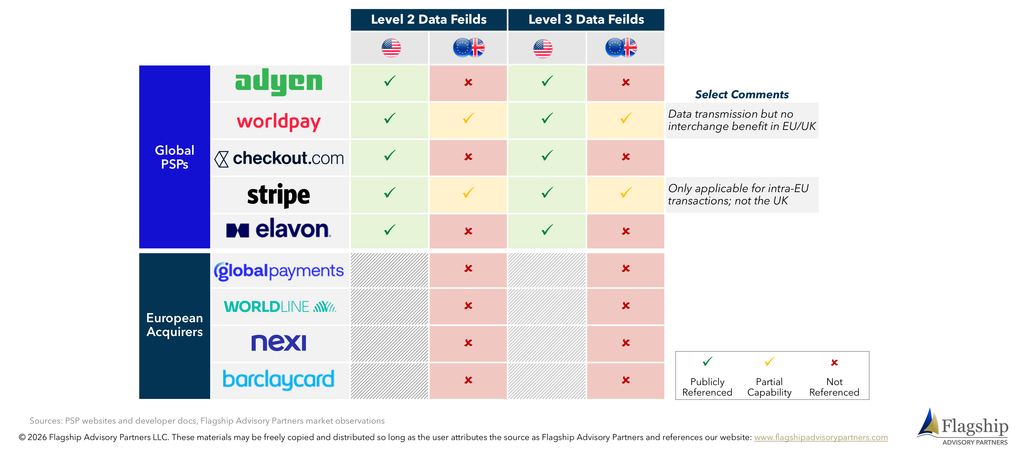
Enhanced data submission in Europe remains patchy. Most major European acquirers do not technically transmit Level 2/3 data and need labor-intensive integration with ERPs and CFO office platforms to offer these at scale. In fact, very few European acquirers today market automatic Level 2/3 invoice data enrichment as a B2B acceptance proposition, as illustrated in Figure 4.
Figure 4: European Acquirer Enhanced-Data Capability Assessment
(select acquirers/PSPs, based on public developer documentation)
Over the next three to four years, e-invoicing platforms and access points will make invoice line-item data reachable at scale and at low marginal cost. An acquirer that connects to that layer can build a genuinely differentiated B2B acceptance proposition: enrich the card transaction with structured invoice data automatically, so the supplier qualifies for large-ticket or enhanced-data interchange by default and deliver reconciled cash application as part of the acceptance product. This opportunity reframes the supplier conversation from “card acceptance is expensive” to “accept card at optimized interchange, with reconciliation handled.”
In the near term, while we don’t expect a landslide shift from bank transfers to commercial cards, we expect cards to become materially more visible in a defined set of B2B payment use cases:
- One-off and ad hoc supplier payments, where onboarding a new payee into accounts payable is a disproportionate effort.
- Recurring supplier payments where buyer-side float and rebate economics justify the acceptance cost, usually negotiated at the relationship level.
- Long-tail supplier spend that AP automation has never economically reached.
- Wider usage of virtual cards, where the structured invoice triggers card issuance automatically, and the remittance data travels with the payment.
Fintech Lending and Supply Chain Finance: The data & distribution unlock for underwriting
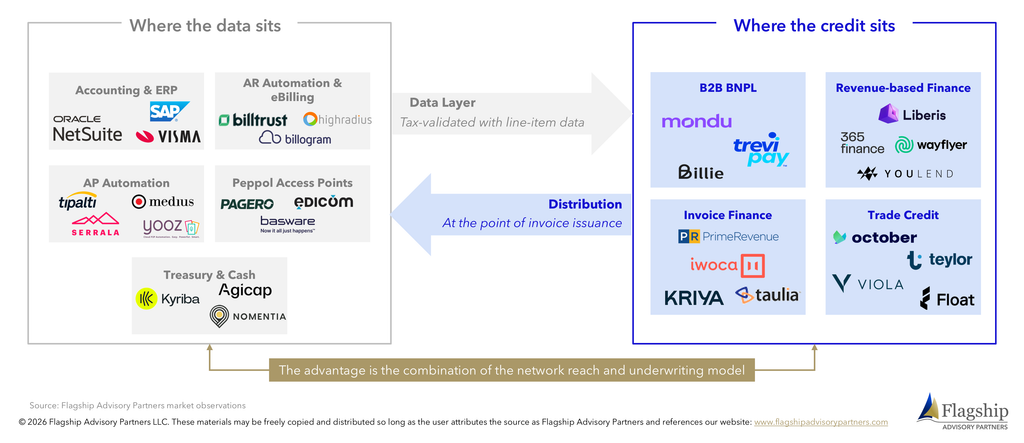
One key structural problem in B2B lending is that underwriting expertise and data sit in different places. Most fintech and bank lenders operate outside the ERP, accounts payable, procurement, and e-invoicing systems where transactions actually originate. They underwrite off filed accounts, bank statements, and periodic, self-reported borrower data, days or weeks after the commercial event. The credit skill is real; its proximity to the invoice is not.
The e-invoicing mandates open two distinct fronts: First, the invoice becomes a structured data layer that materially improves underwriting. Tax-validated, line-item invoice data supports real-time buyer and supplier profiles rather than periodic snapshots, reduces fraud risk, sharpens monitoring, and allows pricing to reflect verified transaction history instead of inferred risk.
Second, the invoicing endpoint becomes a distribution channel. Fintechs that can integrate with or embed in ERP systems, procurement software, or Peppol access points should be well-positioned to benefit from structured underwriting data at scale.
Fintechs that sit at these endpoints know not just who to underwrite, but precisely when to offer embedded lending opportunities (see Figure 5). The winning narrative, therefore, shifts from “who owns the platform” or “who banks the client” to “who combines network reach with the best underwriting model.”
Figure 5: EU & UK Fintech Lending Ecosystem
Strategic Implications for Players
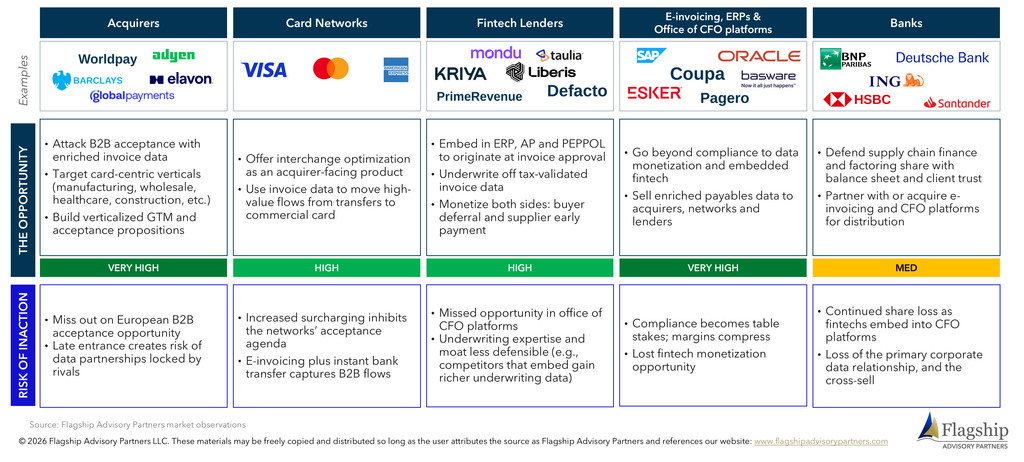
The e-invoicing mandates introduce a clear set of opportunities across market participants. Acquirers can build the first genuinely differentiated B2B acceptance proposition in Europe, relying on invoice data enrichment that defaults suppliers to large-ticket interchange, with reconciliation handled. Card networks can turn interchange optimization into an acquirer-facing product rather than a rate card, because the data prerequisite now arrives free. Fintech lenders can embed tightly with CFO office platforms and originate at the moment of invoice validation across an entire market rather than one ERP at a time. E-invoicing platforms and OFCFO software that sit within the flow can convert compliance revenue into embedded payments and monetization of financing upsides. Banks can strategically explore partnerships with CFO software or acquire platforms or fintech assets that serve B2B payments. In Figure 6, we outline the key opportunities for each player cohort.
Figure 6: Implications and Opportunities for Market Participants
Conclusions
Europe set out to digitize B2B invoicing as a mere software upgrade. What it is actually building is a continent-wide, standardized, addressable transaction-data layer covering essentially every B2B transaction in the single market. That is not a compliance project. It is the foundation of a new B2B payments infrastructure with several years of growth tailwinds.
The commercial card opportunity is real. The data and reconciliation barriers that have blocked supplier acceptance for two decades are being dissolved at no cost to the acquirer. And verified, network-wide receivables data gives fintech lenders an open field to underwrite new financing products at the point of invoicing. We expect that by 2030, the winners will not be the firms that complied best, but those that read a compliance directive as a fintech growth opportunity.
Please do not hesitate to contact Anupam Majumdar at Anupam@Flagshipap.com or Simone Remba at Simone@Flagshipap.com with comments or questions.