
Introduction
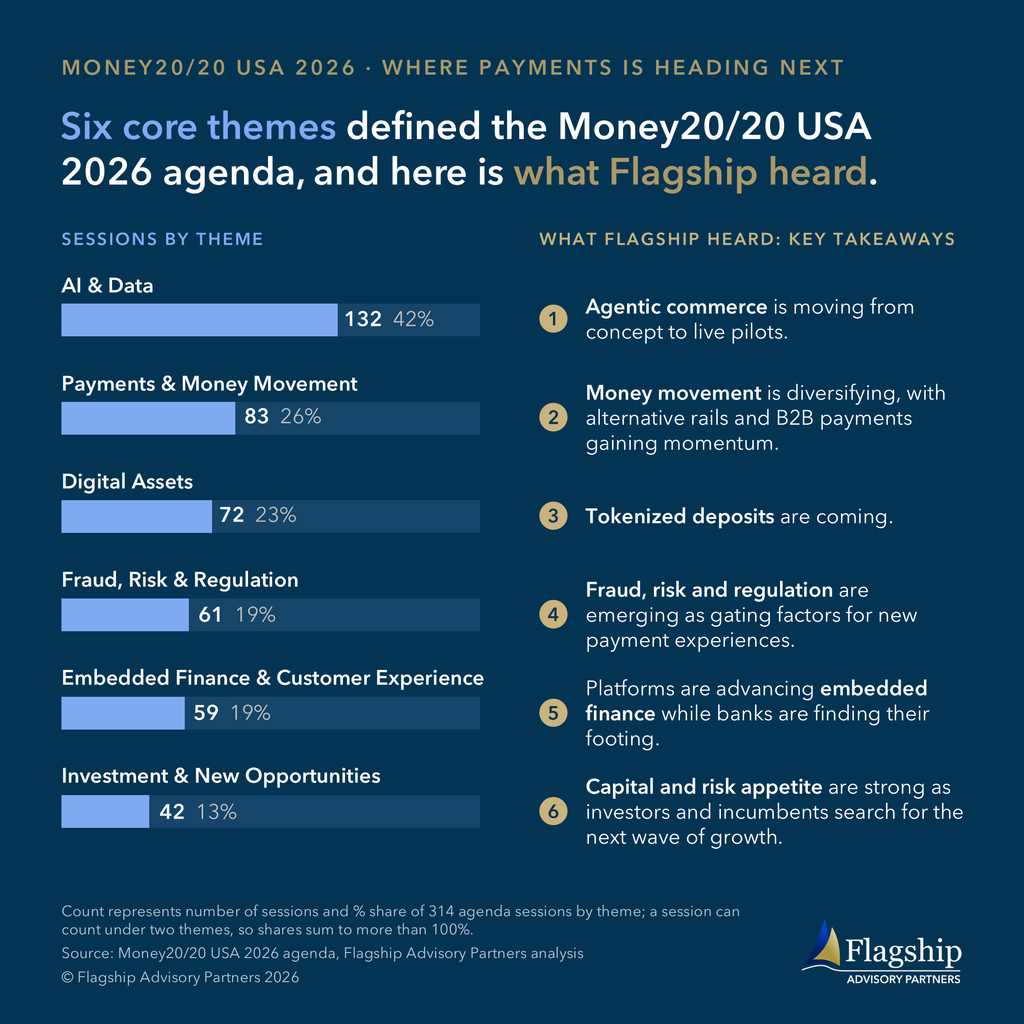
Our analysis of the 314 sessions on the Money20/20 USA 2026 agenda points to six core themes, led by AI and data (42% of sessions), payments and money movement (26%) and digital assets (23%). Conversations at the event added important texture to that picture. The six takeaways below reflect what stood out most to the Flagship team.
Key Takeaways
1. Agentic commerce is moving from concept to live pilots.
Agentic commerce is becoming a practical payments opportunity across both B2B and consumer markets. Multiple panels showed agents beginning to connect purchasing decisions with payment execution. Visa, BILL and Billtrust’s live pilot made the B2B opportunity more tangible: authorized agents complete payments on approved invoices between BILL’s buyers and Billtrust’s supplier network. Development remains largely supply-led, however, and merchants are not yet at the table.
Industry players are preparing for agentic commerce, although the pace of disruption remains uncertain. Most are still working out how quickly agents will reshape commerce and payments, and how best to position themselves as a result. Key open questions include which verticals and segments will be disrupted first, and how far existing merchants and platforms could be disintermediated.
Payment flows are spreading across a wider set of rails. ACH, RTP and tokenized rails are scaling and adding growing pressure on traditional card rails, as businesses look for faster and lower-cost ways to move money.
B2B payments remain a substantial whitespace opportunity, with significant room to digitize and streamline payment flows. Horizontal expansion is visible here too, as AR, AP and adjacent segments converge. Ramp’s launch of accounts receivable alongside its AP automation and expense management offering shows software expanding to cover both money out and money in.
3. Tokenized deposits are coming.
Banks and fintechs are working on tokenized deposits to address liquidity and settlement challenges. While the topic received little dedicated stage time, just 14 of 314 sessions, the right people were in the room: J.P. Morgan’s head of Kinexys spoke, BNY’s head of digital cash attended, and the regional banks behind the Cari Network came in force.
Momentum is building beyond Money20/20 as well. Tokenized deposits were a central topic at Sibos 2026 a few weeks earlier, where Citi, HSBC, Standard Chartered, TCH, Swift and others presented real progress and discussed the practical considerations of implementation and scale. Most regional banks remain in wait-and-see mode. They understand the appeal of bank-controlled deposit tokens, but they are looking for a clear business case and plug-and-play solutions. We expect tokenized deposits to be a much bigger Money20/20 topic in 2027.
Fraud, risk and regulation were one of the most prominent themes at the event, with 61 sessions, nearly one in five on the agenda. Identity, authorization and accountability came up across conversations as new rails, new participants and AI-driven payment flows widen the surface area for fraud and raise the bar for compliance.
These questions are most acute for agentic commerce and stablecoins, where trust and control are likely to determine how quickly adoption scales. Industry players increasingly recognize that this trust layer must be in place first, and the two leading global card networks are already building it. Visa’s Trusted Agent Protocol allows websites to verify authorized AI agents. Mastercard used the event to unveil Stablecoin Security, which screens stablecoin payments for fraud, scams and sanctions risk.
5. Platforms are advancing embedded finance while banks are finding their footing.
Platforms are looking beyond payments and investing heavily in broader embedded finance capabilities. This next phase will connect financial workflows across payment modalities and use cases, as organic builds, partnerships and acquisitions bring complementary payments, lending and banking capabilities into existing software experiences. NMI’s acquisition of Dwolla, for example, was positioned at the event as a complete treasury solution for SMBs, combining card acceptance with bank-payment infrastructure. Platforms without embedded finance offerings are likely to face increasing competitive pressure, particularly as AI disrupts traditional SaaS business models.
Banks increasingly see embedded finance as a fee-income strategy, although execution remains slow. We heard interest in providing risk and compliance services to software companies, as well as continued appetite for card and bank-rail sponsorship. Many banks remain stuck, however, unsure how to structure their go-to-market, define their programs or secure senior management approval to move forward.
6. Capital and risk appetite are strong as investors and incumbents search for the next wave of growth.
Private equity and strategic investors remain willing to deploy capital despite demanding fintech valuations. Buyers are placing a higher premium on durable growth, profitability and defensible positions in customer workflows as AI disruption continues.
Across the industry, the search for growth is pushing players into new territory. One industry leader framed their job as figuring out “Where can we go hunting?”, a question on many minds. For networks, issuers and sponsor banks, the answer increasingly lies in greater risk appetite, with prediction markets, crypto, BNPL and classic high-risk verticals all under consideration. Fintechs and PSPs are pursuing growth through breadth instead, expanding beyond core payments into pay-ins, payouts, wallets and broader embedded finance capabilities to capture a larger share of the value chain.
Conclusion
Money20/20 has evolved considerably over the past few years, mirroring how quickly the industry itself is changing. AI and agentic commerce now sit at the center of the agenda, while payments players are diversifying across rails, products and risk profiles in search of growth. Trust, risk management and bank readiness will determine how quickly that potential is realized, and which players capture the next phase of growth. We look forward to seeing how these themes develop over the coming year and to revisiting them at Money20/20 2027.
Flagship Attendees at Money20/20 2026
Please feel free to reach out to any of us directly with questions or comments:
- Ben Brown at Ben@FlagshipAP.com
- Scott DeHaven at Scott@FlagshipAP.com
- Rom Mascetti at Rom@FlagshipAP.com
- Charlotte Al Usta at Charlotte@FlagshipAP.com
- Peter Taylor at Peter@FlagshipAP.com
- Stephen Ford at Stephen@FlagshipAP.com