
Flagship ranked US commercial card issuers by volume growth, then reviewed each bank’s card marketing to identify the industries it names as a focus. For this analysis, an industry counts only when the bank names it in its own card or payables content: a card product page, a vertical card program, an industry page that names the card, or its own commercial card commentary. Mentions confined to lending, trade finance, or treasury are excluded.
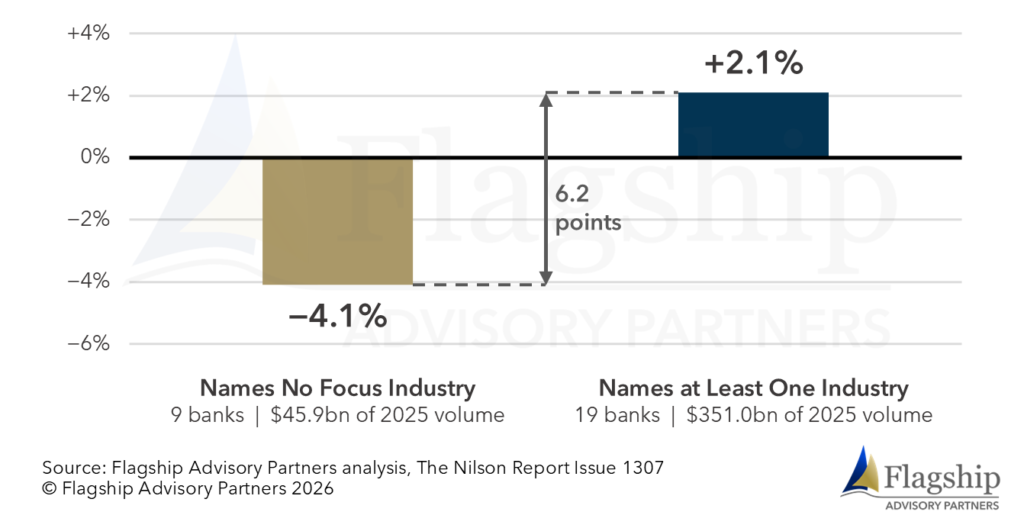
Of the 28 comparable issuers with more than $500 million in commercial card purchase volume, the 19 that named at least one focus industry grew 2.1% as a group. The nine that named none shrank 4.1%.
Figure 1: Industry Focus and Commercial Card Growth
(purchase volume growth 2024 to 2025, volume weighted, 28 comparable US issuers above $500m)
At those nine banks, the alternative is typically product-centric marketing. Their card content is organized around spend type (e.g., purchasing, travel, fleet), eligibility thresholds, rebate tiers, and working-capital metrics. One bank explicitly notes that it serves clients regardless of sector. These elements explain the product and who qualifies for it, but not why a company in a particular industry should bring its payables to that bank. The proposition is then more likely to compete on controls and rebates, dimensions on which commercial card programs often look similar, or where richer economics can trade profitability for acquisition. Without an industry lens, it can also be harder to build the expertise that helps Relationship Managers anticipate a prospect’s payables mix, identify suppliers that are already card-enabled, and estimate how much check or ACH spend could migrate to card.
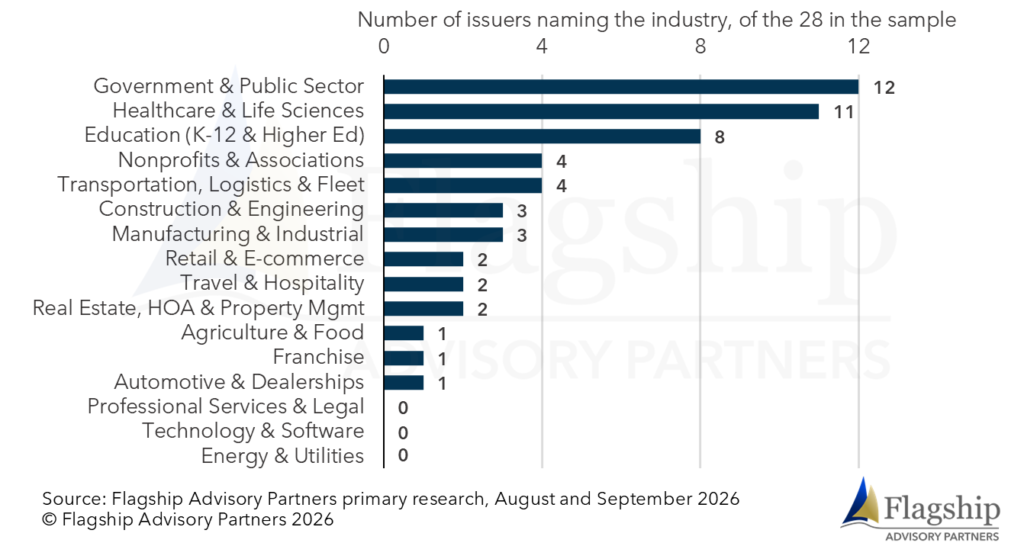
Where industry focus does exist, it is concentrated. Government and public sector are named by 12 of the 28 issuers, healthcare by 11, and education by eight. Together, those three account for more than half of industry mentions across the sample.
Figure 2: Where Industry Focus Concentrates
(US commercial card issuers naming each industry in their card marketing)
Part of that concentration has structural explanations. Government and higher-education buyers often procure card programs through competitively bid contract vehicles, so banks holding those mandates have a reason to feature them prominently. Transportation, logistics and fleet also map naturally to established commercial card use cases. The distribution thins quickly below the top five, likely reflecting a mix of underdeveloped propositions and genuinely smaller card-addressable spend.
We are not suggesting that simply naming an industry causes growth. A bank that markets to an industry is usually a bank that already serves it. But the absence of an explicit industry strategy can still be diagnostic: it may indicate that card capabilities, platform investment and RM expertise have not been organized around the distinct payables needs of priority client segments.
Choosing focus verticals is not a simple exercise. Issuers should start with clarity on their business objectives: a large government opportunity can be attractive if your goal is gaining scale or winning a high-impact reference, but less attractive if you are trying to generate incremental near-term margin. Once your goals are clear, banks should prioritize industries where they already have a commercial-banking presence, then use a test-and-learn approach to see where that position translates into a credible right-to-win in cards. Pick a few industries, talk to customers to learn about their needs, build a sales narrative, and test its effectiveness with a handful of prospects.
From there, issuers should identify the capabilities each potential target industry requires (e.g., grant-level coding, integration with a dominant vertical ERP, supplier enablement across a fragmented supply base, or virtual card issuance inside a procurement workflow). These are product, pricing, integration, and operating-model choices, not merely marketing decisions. Each should be tested against what the platform delivers today, with the investment and return of closing any gaps made explicit. That exercise is what separates a genuine focus industry from a page on a website, and it is not a small piece of work, but the market evidence shows it can generate real business impact if done right.
Please do not hesitate to contact Allan Reynolds at Allan@FlagshipAP.com with comments or questions.