
Credit products are being repositioned as the front end of broader financial and commercial platforms, as issuers and fintechs compete less on headline rewards and more on the ecosystem around the card, including travel, lifestyle, expense tooling, and increasingly AI. Q1 2026 brought a wave of premiumization: higher fees anchored to richer benefits, non-traditional spend categories like housing and brokerage, and neobanks moving upmarket into commercial cards. In parallel, agentic commerce has emerged as the newest battleground, with major players racing into AI-driven checkout.
While these launches signal clear strategic intent, most sit at the premium or commercial end of the market or remain early in rollout. The snapshot below highlights noteworthy additions to the credit issuing market in Q1 2026 and the broader trends they exemplify. We will continue to monitor how these approaches progress and which models ultimately reshape issuer strategy.
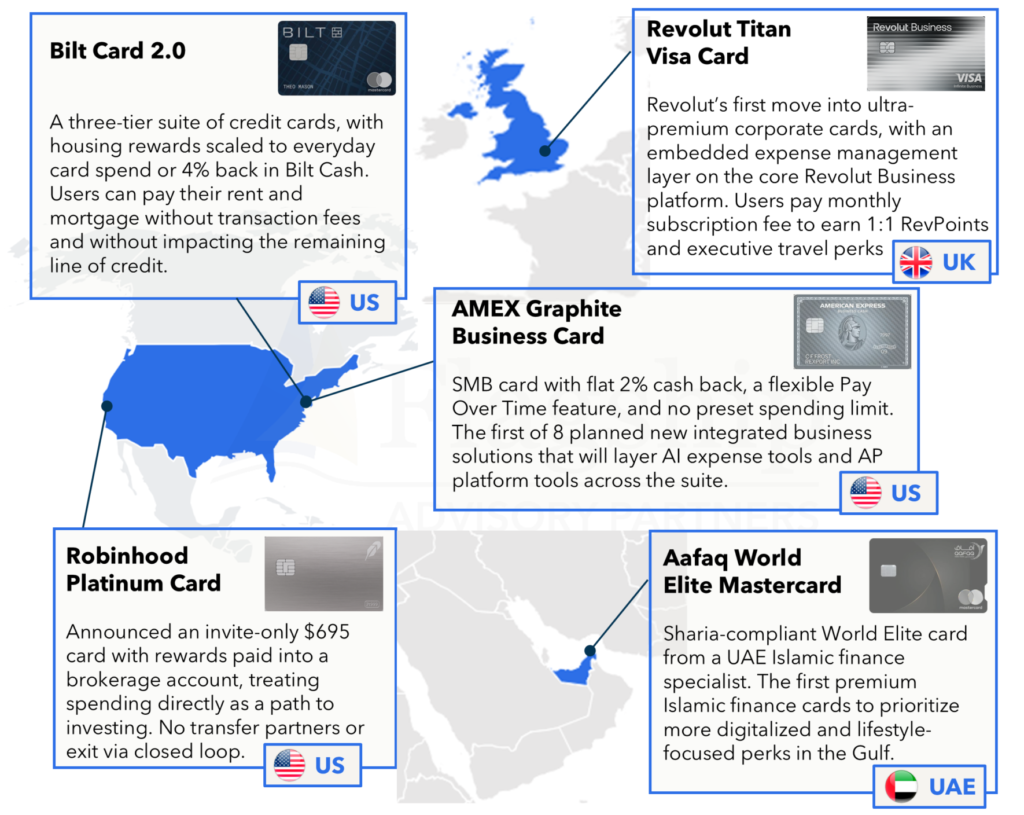
Q1 2026 Credit Market Updates (January – March 2026)
(select inventory of additions and changes terminations in credit products)
Sources: Company websites and press releases, Flagship analysis
Select Themes in Q1 2026:
- Premiumization intensified across regions. Issuers pushed fees and benefits higher, from Robinhood’s invite-only $695 Platinum to Aafaq’s premium World Elite in the Gulf.
- Rewards are expanding into non-traditional spend categories. Bilt extended fee-free rewards from rent to mortgages.
- Redemption is being tied to investing. Robinhood routed card rewards straight into a brokerage account turning everyday spend into investing rather than statement credits or points.
- Challenger banks moved upmarket into commercial. Revolut’s Titan folds executive travel perks and native expense management into a single corporate card, a direct challenge to legacy commercial issuers like Amex at the premium end.
- AI and platform depth as a differentiator. Amex positioned Graphite as the opening move in its largest-ever commercial expansion, layering AI expense and AP tooling across the suite.
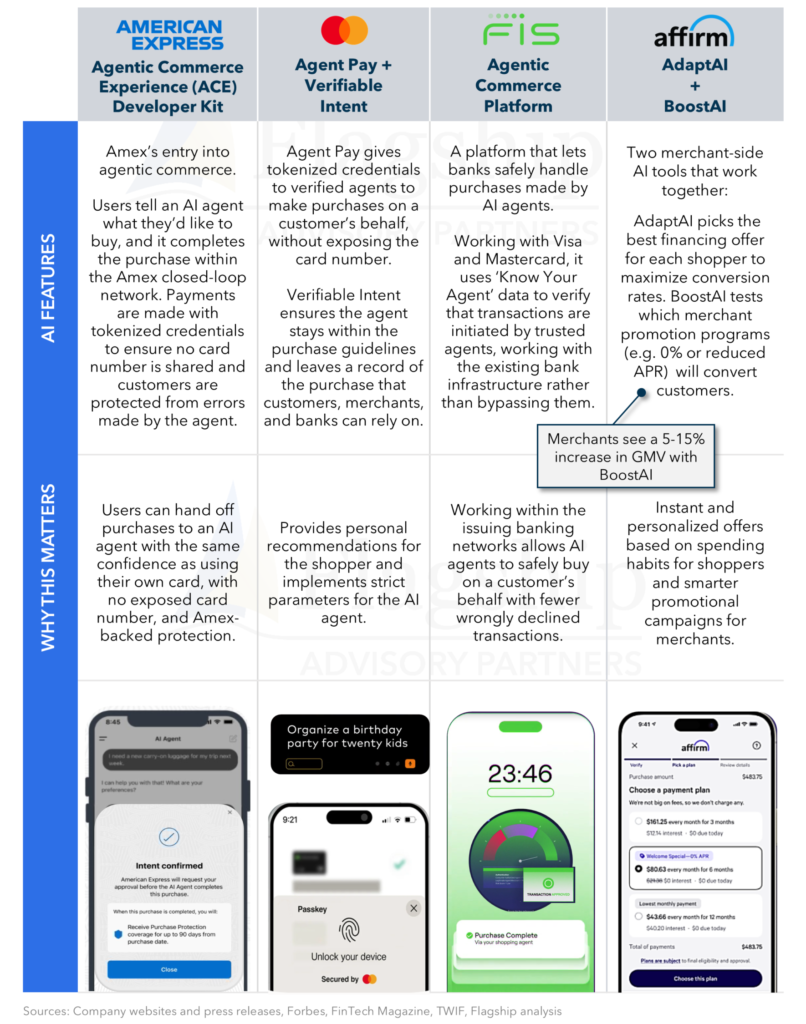
Market Theme Spotlight: AI Tools in Credit Products
(non-exhaustive examples, as of May 2026)
This quarter, agentic commerce solidifies as the next credit battleground. Major players are racing to make sure their credentials, not a default card on file, execute AI agent purchases.
Providers are going about it differently: Amex is building agent purchasing into its network, Affirm is using AI to tune merchant financing offers, FIS is helping banks verify agent transactions without overhauling their systems, and Mastercard is issuing verified credentials that record what the customer actually asked for.
But what most providers are really selling is confidence and trust, because the thing holding issuers back is the question of who’s responsible when an AI agent gets a purchase wrong. Features such as liability cover, verifiable intent, and agent authentication that give issuers the confidence to let AI transact on their behalf.
The takeaway for issuers is simple: if your card isn’t set up to work with AI shopping agents while displaying a commitment to responsibility, it risks being passed over.
UX Deep Diver: Amex ACE Developer Kit Purchase Flow
The process starts with the verification of a trusted AI agent to work within the Amex network. The user describes what they want to purchase and sets the parameters; the agent finds a matching purchase; and Amex sends a single approval request, all without exposing a card number or involving third parties to resolve disputes. The flow below shows the process end-to-end:
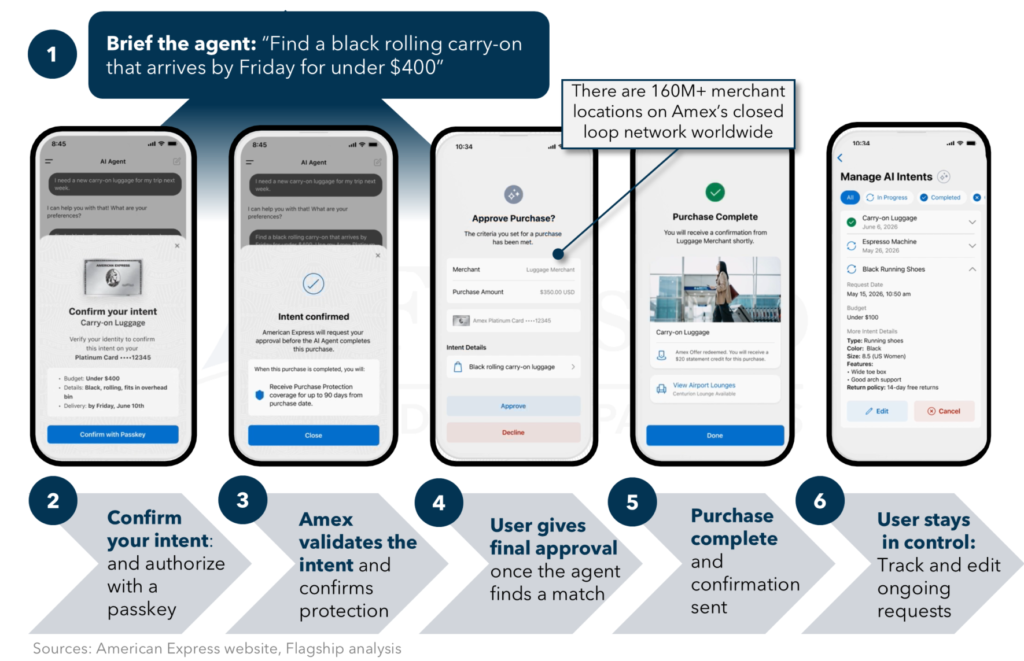
Amex is furthest along here since it acts as the card issuer, the network, and the merchant’s bank all at once
Setup is deliberately under the user’s control: the agent is registered to the Amex network, the user authenticates their account, and spend limits and merchant rules are set from the beginning. Purchase intent is defined once, then a single-use tokenized credential executes each purchase with the real card number never exposed, and Amex covers eligible agent errors.
End-to-end control is only possible because Amex owns issuer, network, and acquirer in one stack, letting it enforce intent and resolve disputes with no third-party involvement. Open network issuers cannot replicate this natively.
Flagship Commentary & Highlights
- In Q1 2026, issuers moved beyond competing on the card itself and started competing on everything around it. Rather than incremental product enhancements, issuers are competing to own the ecosystem around the transaction.
- As agentic commerce moves from announcement to live product, issuers should consider how to stay relevant and secure. The players building the trust layer now, including liability cover, verifiable intent, and agent authentication, are positioned to become the default.
Please do not hesitate to contact Ben Brown at Ben@Flagshipap.com with comments or questions.