
Of all the use cases where stablecoins have emerged, cross-border payments have the clearest product-market fit. But that fit is not uniform; it is concentrated in specific corridors, specific transaction types, and operating models.
Cross-border payments remain one of the most friction-laden, expensive, and opaque segments of global finance. Businesses wait three to ten days to settle international invoices. Migrants sending money home surrender as much as 6–8% of every dollar to a chain of intermediaries. Emerging–market importers routinely pay FX spreads of 200–300 basis points to obtain hard-currency liquidity. Stablecoins offer a structurally promising answer to all these problems, and adoption is now accelerating from both incumbents and challengers.
In this article, we examine the two most mature cross-border use cases: B2B payments and P2P remittances. We also size the addressable opportunity, map where the fit is strongest, and set out the conditions under which widespread adoption will or will not materialize.
Stablecoins Fit for Cross-Border Payments
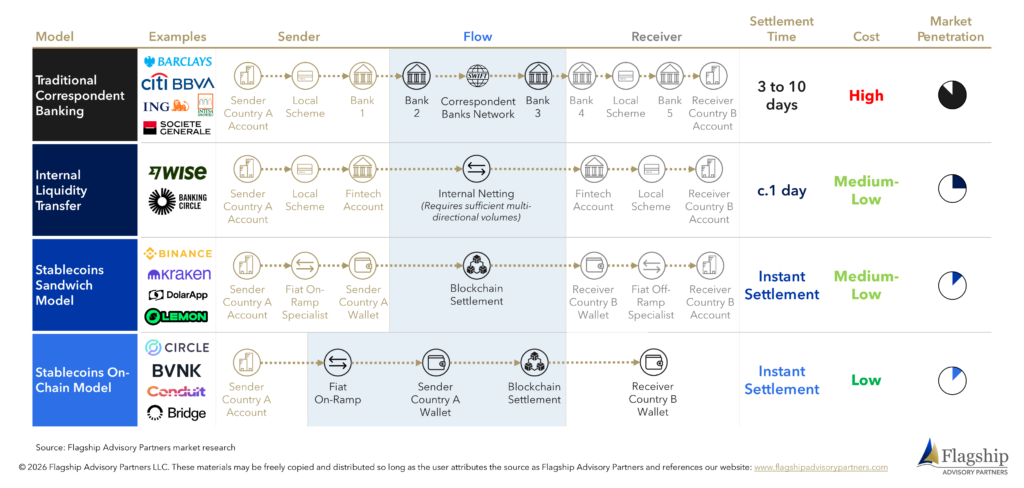
Stablecoins provide a structural alternative to existing cross-border payment rails. Most cross-border payments are processed through correspondent banking, in which banks maintain liquidity through a network of intermediaries between payer and payee. The core problem with correspondent banking is the model itself: each intermediary hop requires pre-funded liquidity trapped in nostro accounts, adds FX mark-ups, and adds a layer of opacity. A payment from Bangkok to Buenos Aires can touch five to seven banks before arriving, each adding time, cost, and uncertainty.
Nimble cross-border fintechs such as Wise and Banking Circle have improved on this by building proprietary bilateral banking networks and internalizing liquidity, netting flows to reduce the number of actual cross-border movements required. But these models have limits. They require sufficient bilateral volume to net efficiently, and they still depend on local banking partners at either end; cut-offs and holiday calendars persist.
Stablecoins address the cross-border payments network problem differently. Rather than improving the correspondent network, they bypass it. A blockchain-settled payment can move from a wallet in London to a wallet in Lagos in seconds, at a network fee of less than two cents, independent of banking hours. The value of the stablecoin proposition is unique: accessible (borderless, 24/7, no bank account required), fast (seconds to minutes, independent of banking calendars), cheap (minimal network fees, fewer intermediaries taking spreads), and programmable (smart contracts enabling conditional and automated payment logic).
While stablecoin cross-border payment models are still emerging, we observe two key stablecoin operating models today, as depicted in Figure 1. The “sandwich model” is the most prevalent today: fiat is converted to stablecoin at the sending end by a local on-ramp provider, settled on-chain, and then converted back to local fiat at the destination via an off-ramp specialist. The fully on-chain model keeps the entire flow in stablecoins, requiring both sender and receiver to hold digital assets.
Figure 1. Cross-Border Payment Flows
Sizing the Stablecoin Cross-Border Opportunity
We estimate that stablecoins can meaningfully compete for $22 trillion of the $35 trillion in annual B2B cross-border flows, and approximately $295 billion of the $455 billion in annual digital remittance volume. Together, that represents a multi-trillion-dollar structural disruption opportunity.
B2B Cross-Border Payments
Figure 2. Stablecoin B2B X-Border Total Addressable Market
(2025)
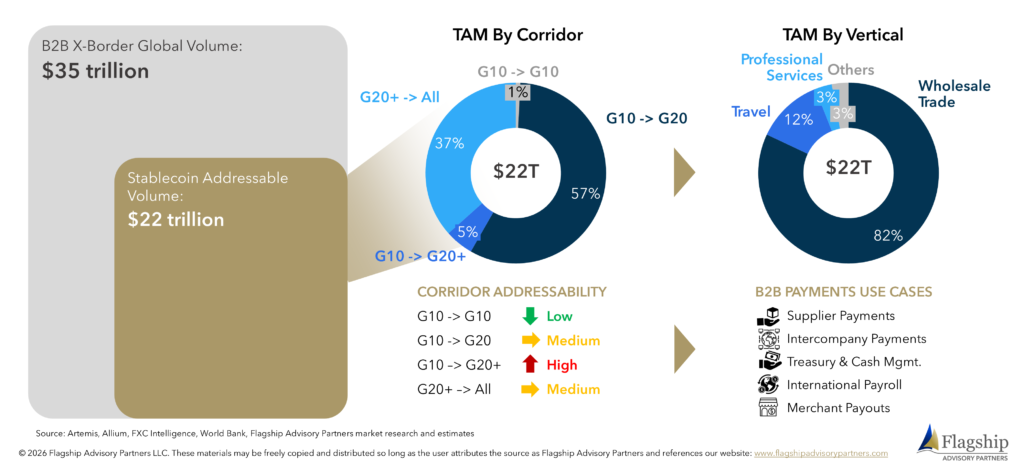
Corridor dynamics matter significantly for B2B stablecoin adoption. G10-to-G10 flows, for example USD/EUR payments, demonstrate low addressability: FX spreads are tight, local payment rails offer instant settlement, and stablecoin rails offer limited net benefit. Addressability rises across G10-to-G20 corridors and is highest in G10-to-G20+ and non-G20-to-non-G20 flows, where correspondent chains are longest, FX spreads are widest, and settlement certainty is lowest. Emerging-market-to-emerging-market payments, historically the worst-served flows in global banking, are the strongest structural fit.
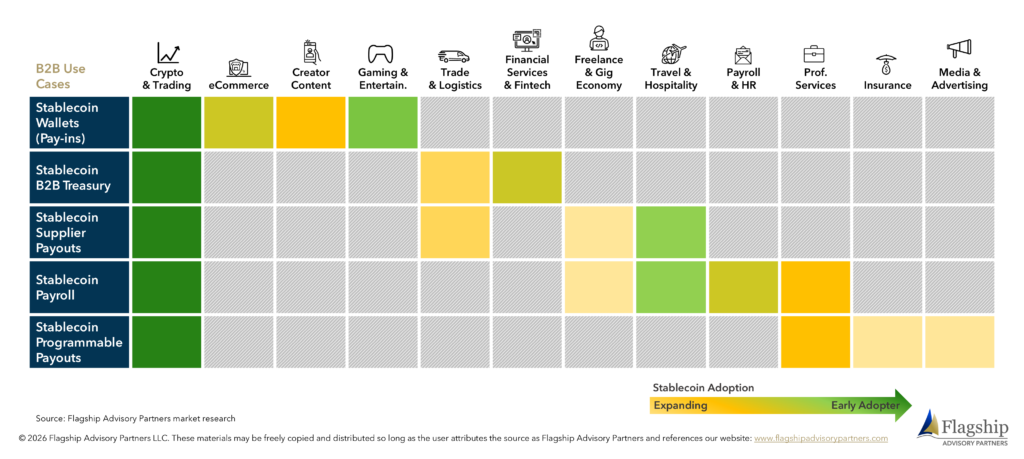
Use case maturity varies across industry verticals (Figure 3). Stablecoin wallets, supplier payments, and treasury and cash management show the highest maturity among enterprises, while international payroll is growing fastest among SMEs and distributed/gig workforces. By vertical, crypto and trading firms remain the heaviest users today, while there is clear acceleration across wholesale trade (e.g., import-export), travel, digital platforms, gaming, and professional services.
Figure 3. B2B X-Border Stablecoin Use Cases and Industry Fit
Remittances
Figure 4. Stablecoin P2P Remittance Total Addressable Market
(2025)
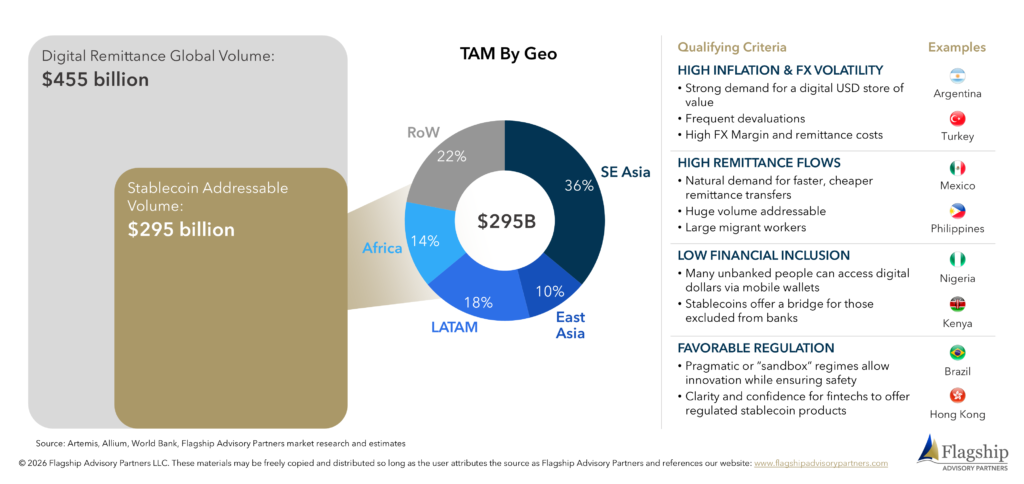
The global digital P2P remittance market reached approximately $455 billion in 2025. Stablecoin remittances currently account for 3–4% of global digital remittance volumes and are growing rapidly. We estimate that $295 billion of this is addressable by stablecoins (see Figure 4). Addressability concentrates in recipient corridors that combine high inflation and FX volatility, high remittance dependence, low financial inclusion among the recipient population, and a favorable or at least neutral regulatory posture toward digital assets. South and Southeast Asia, Latin America, and Africa collectively represent the largest share.
A common thread is that recipients in these markets lack access to stable financial accounts, face punitive conversion rates, and/or are subject to capital controls that make holding USD-denominated stablecoins intrinsically valuable, not merely as a payment rail but as a store of value. That dual utility is what makes markets such as Argentina, Venezuela, Turkey, Nigeria, Kenya, and the Philippines the highest-conviction stablecoin remittance corridors. It also implies a strategic asymmetry worth noting: in these markets, the demand driver is dollar access, and the payment use case is downstream of it.
The Market is Ready: Signals of Adoption Picking Up
Amid broader market developments, the directional signal is unambiguous: stablecoin adoption in cross-border payments is accelerating, and the major incumbents are not waiting on the sidelines.
Figure 5. Stablecoins Announcements in Quarterly Earnings Reports
(# of cumulative “stablecoin” mentions across four P2P remittance & B2B/B2C providers on the tagline)
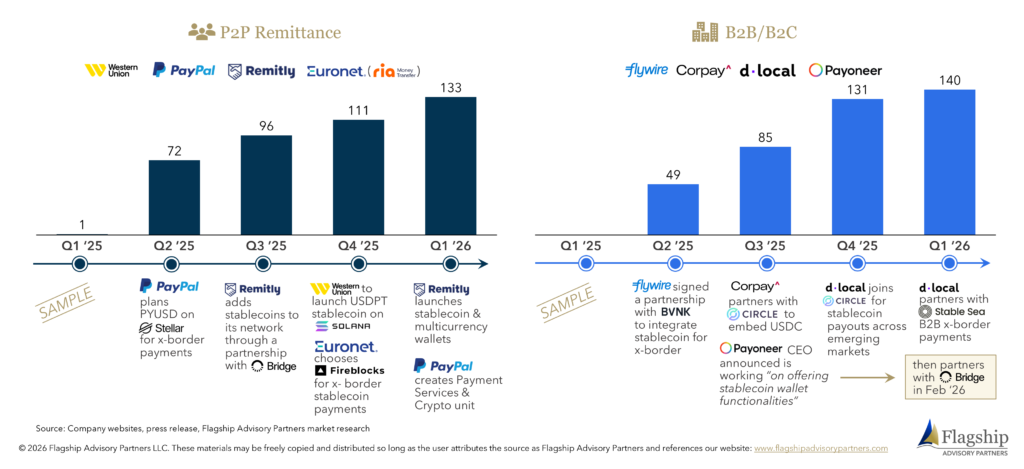
As illustrated in Figure 5, our tracking of earnings call transcripts from leading P2P remittance and B2B cross-border payment companies reveals a step change in stablecoin engagement throughout 2025 and into 2026. In remittances, established players like MoneyGram have introduced a new wallet and remittance app in Colombia, allowing users to receive funds directly in USDC, hold them where supported, or convert them to cash through local MoneyGram agents. Another established player, Remitly, added stablecoins to its network through a partnership with Bridge. Western Union is also preparing to launch a USDPT stablecoin on Solana. On the B2B side, Flywire signed a stablecoin partnership with BVNK; Corpay embedded USDC via Circle; Euronet launched stablecoin based payouts in Q1, ’26 and flagged key investments in using the technology for transaction settlements; dLocal joined Circle to power stablecoin payouts across emerging markets and partnered with StableSea for cross-border payments. Payoneer’s CEO announced that the company is actively working on stablecoin wallet functionality following its partnership with Bridge. In treasury, Kyriba has integrated stablecoin payment rails into its treasury platform through a partnership with Fipto, enabling companies to execute near-instant cross-border transfers alongside traditional fiat payments.
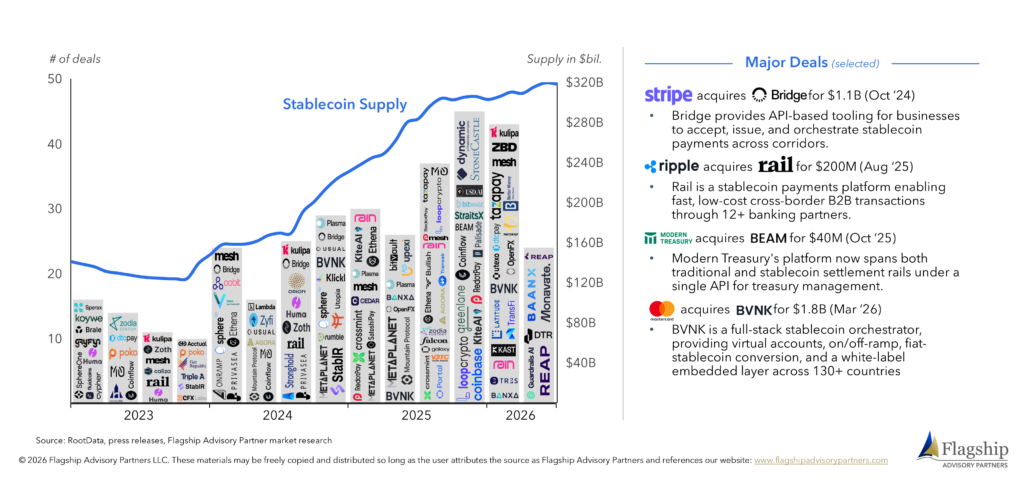
M&A activity (see Figure 6) is further corroborating the strategic conviction. Since Stripe’s $1.1 billion acquisition of Bridge in late 2024, M&A has been rampant. For example, Mastercard’s recent acquisition of BVNK showed growing interest among card schemes in modernizing their rails. Modern Treasury acquiring Beam, Ripple acquiring B2B payment platform Rail.io, and MoonPay acquiring Iron, Meso, and Helio are other examples. Clearly, the era of “wait and see” is over, and the era of building and buying has begun.
Figure 6. # of Stablecoin Payment Deals & Stablecoin Total Supply
(global payment deals includes M&A, pre-seed, funding series; 2023-Q2 2026)
The Cost Question: Where Stablecoins Win, and Where They Do Not
One of the most commonly cited advantages of stablecoin in cross-border payments is cost. The reality is more nuanced: stablecoins can materially reduce structural costs, but the economics of on and off-ramps often determine whether users actually capture those savings.
In the fully “on-chain” model, the advantage is unambiguous. Fewer intermediaries eliminate layered FX spreads and handling charges. Network fees on major payment chains (Base, Solana, Polygon) are typically under $0.02 per transaction. Near-instant settlement releases float and pre-funding, improving capital efficiency for senders and receiving agents alike. Programmability reduces manual reconciliation overhead.
In the stablecoin “sandwich” model, the advantage is unclear and conditional. FX conversion at the on and off-ramps is where economics erode. In emerging-market corridors with few off-ramp options, conversion costs can more than offset network savings. Compliance costs in a blockchain context, and licensing requirements add further costs when operators rely on local partners rather than holding licenses directly.
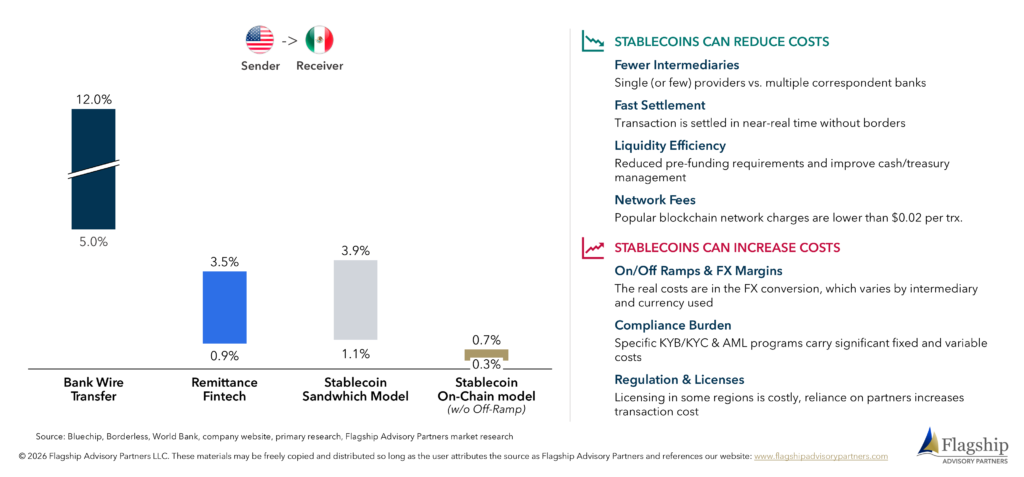
Figure 7 illustrates the economics for a $100 US-to-Mexico remittance. An on-chain transfer shows a material cost advantage over both a traditional wire transfer and a remittance fintech; the sandwich model, on the other hand, shows a far wider range, reflecting gaps in off-ramp coverage that materially affect unit economics. The conclusion for business case owners is therefore that the cost advantage is a property of the operating model and the corridor, not of the technology per se. As is evident, any business case built on “stablecoins are cheaper” without a ramp-economics-modeled corridor-by-corridor approach is likely to overstate the saving.
Figure 7: X-Border Remittance Cost by Payment Archetypes
(for $100 remittance transaction, in % estimation)
Remaining Hurdles: For Widespread Adoption
Despite the accelerating momentum, a few key structural questions are likely to determine the pace and shape of mainstream stablecoin adoption.
Regulatory completeness remains a work in progress. In the US, the GENIUS Act (signed into law July 18, 2025) provides a comprehensive framework for stablecoin issuance. Taking effect the earlier of January 18, 2027 or 120 days after final rulemaking, the GENIUS Act provides a comprehensive framework for stablecoin issuance, and in the EU, MiCA (applied from 30 December 2024) establishes clear rules for crypto-asset issuance, including stablecoins. These are meaningful steps forward. But regulatory frameworks in the most critical growth markets (e.g., Southeast Asia, Sub-Saharan Africa, Latin America, and the Caribbean), remain uneven, creating compliance complexity for operators managing multi-jurisdictional licensing stacks.
Compliance infrastructure is improving, but not yet standardized. KYC/AML obligations in a blockchain context require on-chain screening, wallet attribution, and monitoring against OFAC and other lists in near real time. The tooling has matured significantly, but cost and integration complexity remain friction points, particularly for emerging market operators with thin margins and limited technical capacity.
Institutional adoption of stablecoins requires confidence in issuer soundness (e.g., are reserves truly 1:1 and independently audited?), platform security (e.g., are smart contracts and custody arrangements robust?), and regulatory standing (e.g., will stablecoin holdings be legally recognized in five years?). Regulations (e.g., GENIUS Act and MiCA) outline requirements for periodic reserve disclosures and audits, but trust accumulation takes time.
Finally, the off-ramp challenge in emerging corridors remains real. In markets where only one or two providers can convert stablecoins to local fiat, those providers hold significant pricing power that can erode the cost advantages that make stablecoin rails compelling. Building competitive, multi-provider off-ramp ecosystems in frontier markets is a necessary condition for the P2P value proposition to reach the populations who need it most.
Conclusions
Stablecoins in cross-border payments are past the point of being a promising experiment. They are an emerging layer of global payments infrastructure, already producing real volumes and real cost savings in the corridors where they matter most. The strategic question is no longer “if” but “where, when, and with whom.”
But the prize is not uniform; it is corridor-, use-case-, and operating-model-specific. Key adoption hurdles remain: uneven regulation in the fastest-growing receive markets, concentrated off-ramp liquidity, and trust that accrues only with a track record. These are largely timing constraints, and each should ease as regulatory frameworks converge and corridor liquidity deepens. The advantages will accrue to early movers who commit now to the use cases and corridors where the economics already hold.
Please do not hesitate to contact Anupam Majumdar at Anupam@FlagshipAP.com and Alessandro Mighetto at Alessandro@FlagshipAP.com with comments or questions.