
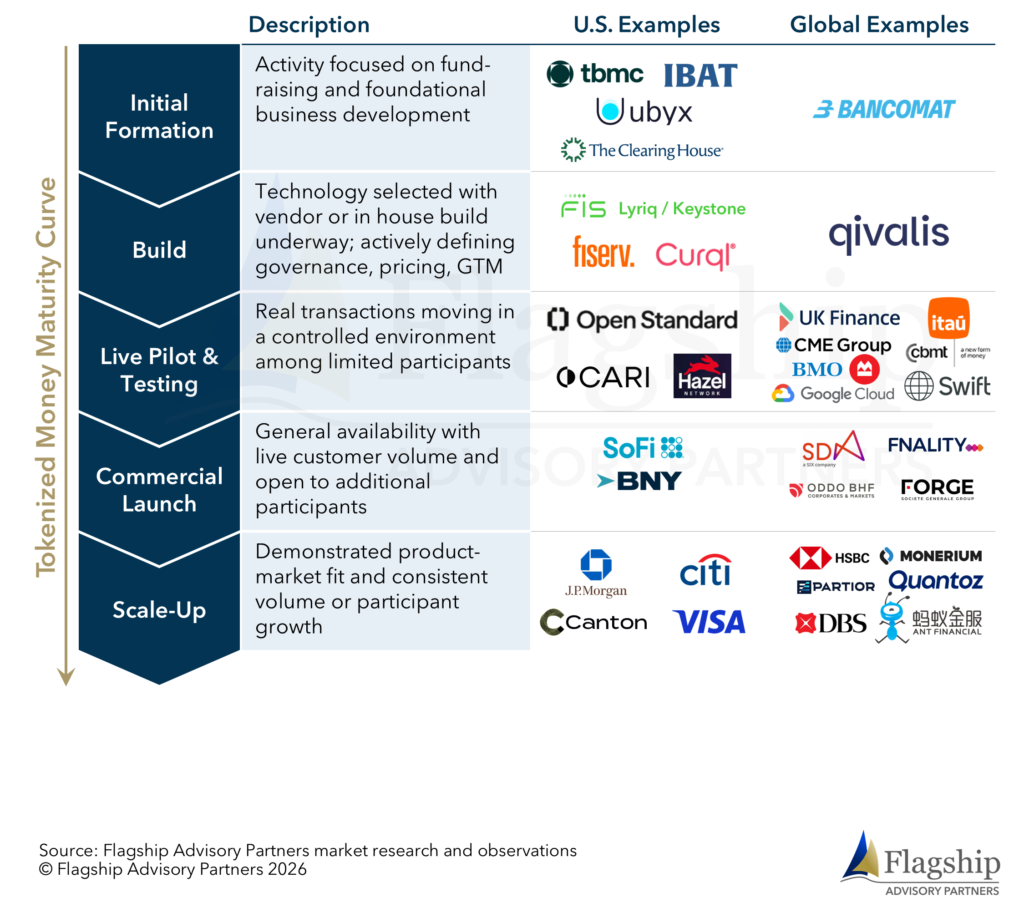
Tokenized deposits are having their moment. Following the surge of stablecoins, banks and financial institutions worldwide are announcing coalitions, forming consortia, or already running live solutions to bring deposits, securities, and payments on-chain.
Tokenized Money Maturity Landscape
(select initiatives, not comprehensive)
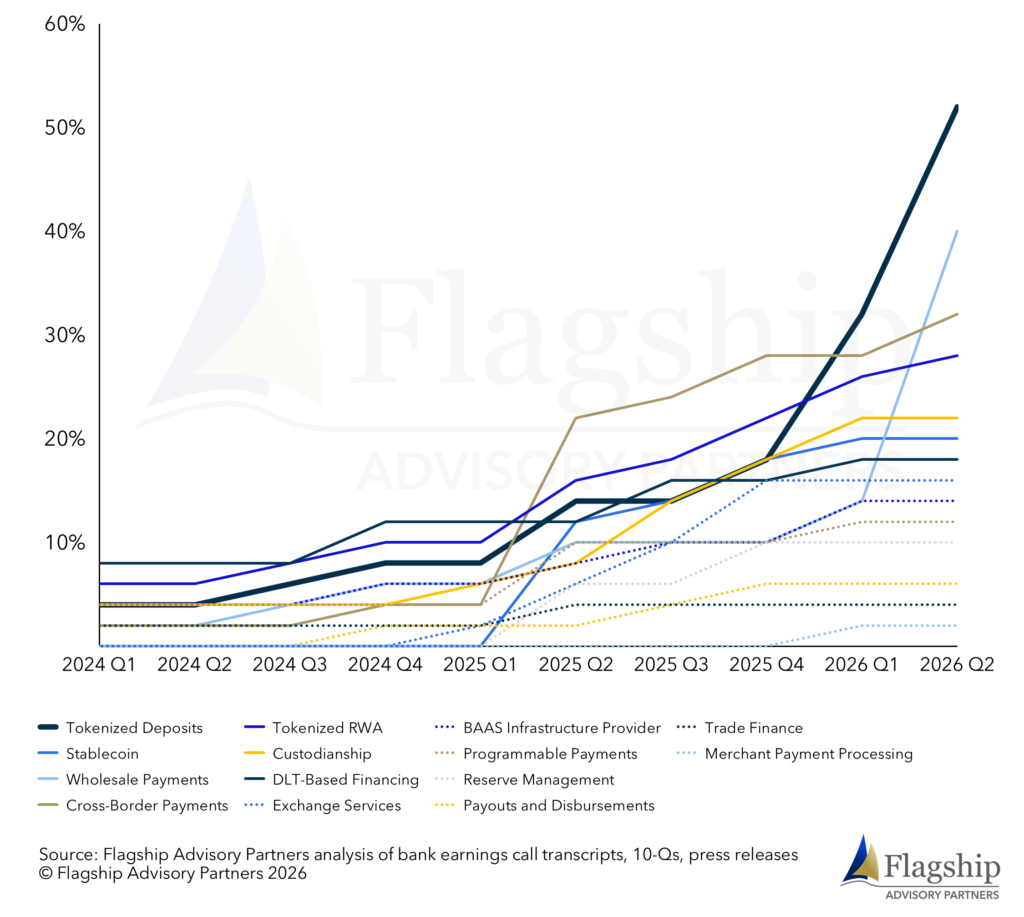
More than half (52%) of the top-50 U.S. banks are now evaluating or implementing tokenized deposits, based on our analysis of each bank’s public statements and filings, a steep increase from just 18% at the end of 2025. Wholesale payments (interbank settlement) are the top DLT use case for these banks, with cross-border payments and tokenized real-world assets following behind. Major U.S. banks are not unique; interest in tokenized money spans both sides of the Atlantic and every size of institution.
Tokenized Money Capability Exploration
(% of top-50 U.S. banks by assets mentioning the DLT-related use case publicly)
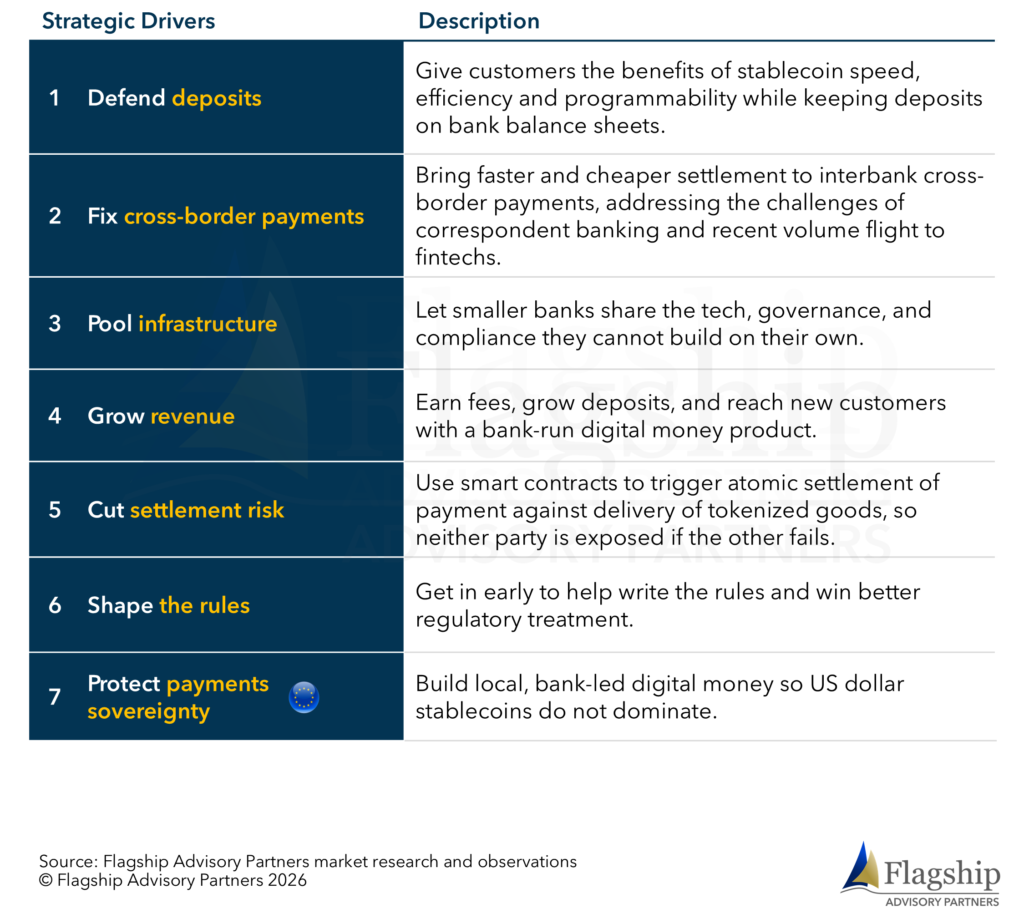
There are seven recurring strategic drivers across initiatives. Deposit defense against stablecoin issuers ranks highest, followed by efficient cross-border settlement (Partior, HSBC, Project Agora) and the ambition to build interoperable, shared infrastructure that pools costs, governance, and technology scale across members (Canton Network, Cari, Ubyx). For Europeans, there is also a clear motivation to build a domestic payment capability that preserves monetary sovereignty.
Strategic Drivers and Themes for Bank Initiatives to Tokenize Money
(non-exhaustive)
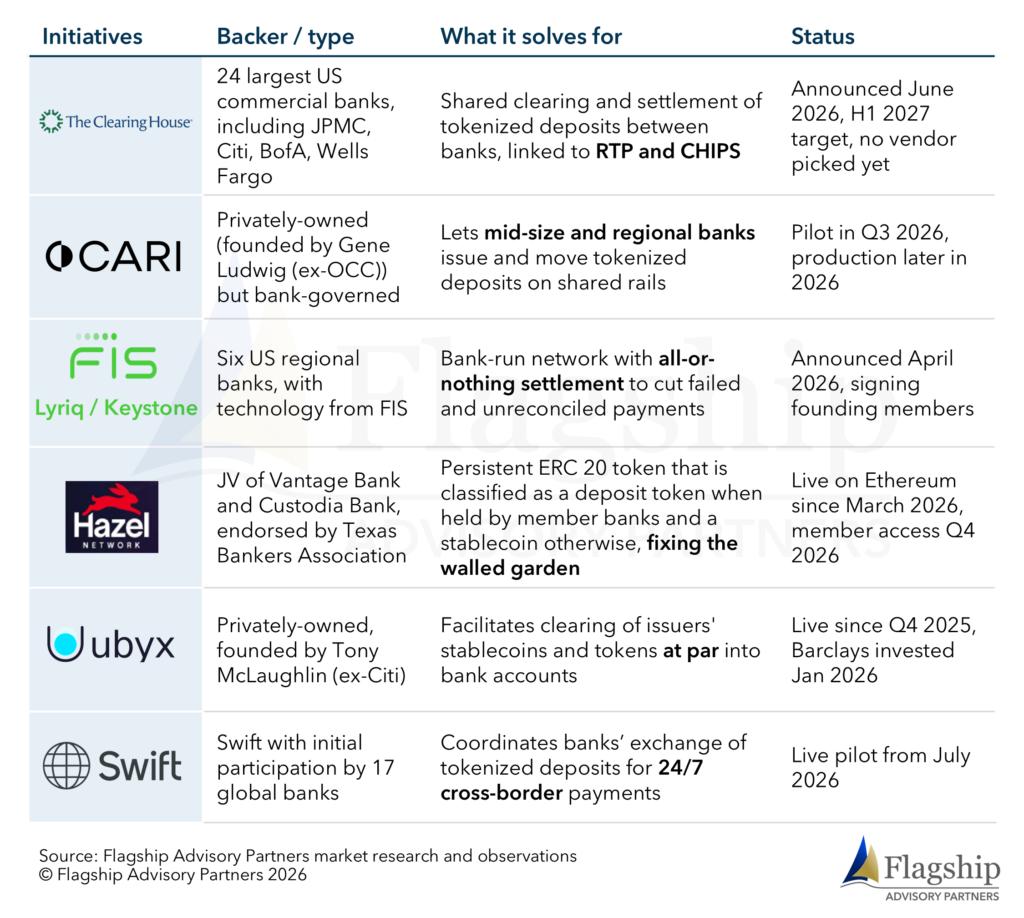
The pace of announcements is building. In February, five U.S. regional banks announced they’d collaborate on a tokenized deposit consortium named the Cari Network. In April, FIS and six U.S. banks announced they’d collaborate on something similar. The next month, in May, SoFi became first national US bank to launch its own stablecoin. Two big announcements followed in June: first, The Clearing House and 17 large banks went public with their plans to build a clearing and settlement solution for on-chain commercial bank money; then several weeks later, over 160 companies led by Visa and Stripe launched Open Standard, a consortium that will issue Open USD, a US dollar stablecoin with shared governance and reserves. In Europe, Qivalis, an association of roughly 40 major banks, plans to launch a MiCAR-compliant stablecoin by the end of 2026.
Notable Tokenized Money Initiatives For US Banks
(non-exhaustive)
Not every story is a success. USDF, the first bank-minted token consortium, went live in 2022 but moved before regulators and bank demand were ready, and the network stalled. The regulatory environment has changed dramatically under the Trump Administration, so conditions are different today, but financial institutions are also acutely aware that another election is coming in 2028 and policies could change again. We see a broad sprint to advance tokenized money now so that it’s a demonstrable good before regulations can change. The risk with that approach is that the industry could end up with a solution searching for a problem.
Tokenized Money Case Studies
(select initiatives)
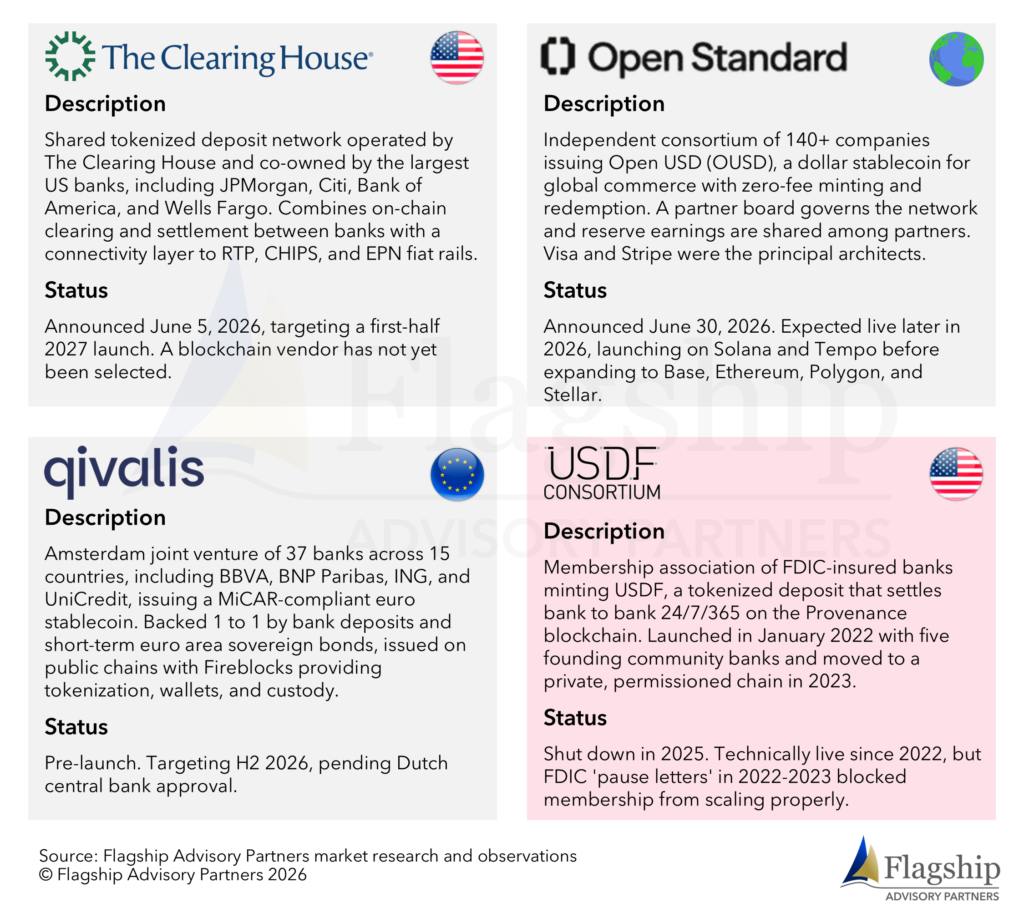
The market is active worldwide, but paths to adoption, infrastructure choices, technology capabilities, go-to-market, and governance vary widely, and no clear winner has emerged. Dozens of schemes are being built in parallel, and almost none of them talk to each other. In some ways, we are re-creating the problems of our current financial system with new technology. Interoperability, through shared standards, clearing and settlement layers, and cross-network DLT infrastructure, is where the next wave of value in tokenized deposits will be achieved.
Please do not hesitate to contact Ben Brown at Ben@Flagshipap.com, Will Hay at Will@Flagshipap.com, or Alessandro Mighetto at Alessandro@Flagshipap.com with comments or questions.