
Agentic commerce has continued to evolve over the last six months. Adobe data shows AI-driven traffic to travel and retail merchants reached new highs in Q2 (but to be fair, it’s still less than 1% of total retail visits), and AI-referred visitors now stay longer, bounce less, and spend more than traditional traffic.
Our research also shows that most large merchants have not moved forward on true agentic payments. Across the same set of 80 large merchants in the US and EU that we reviewed in December/January (Agentic Commerce Market Tracker), we have not seen any additional brands declare support for payments by autonomous AI agents.
1. Agentic Solutions Observed at Top US/EU Merchants, Aug 2026
(implemented solutions across US & EU Top 10 companies ranked by revenue, n = 80)
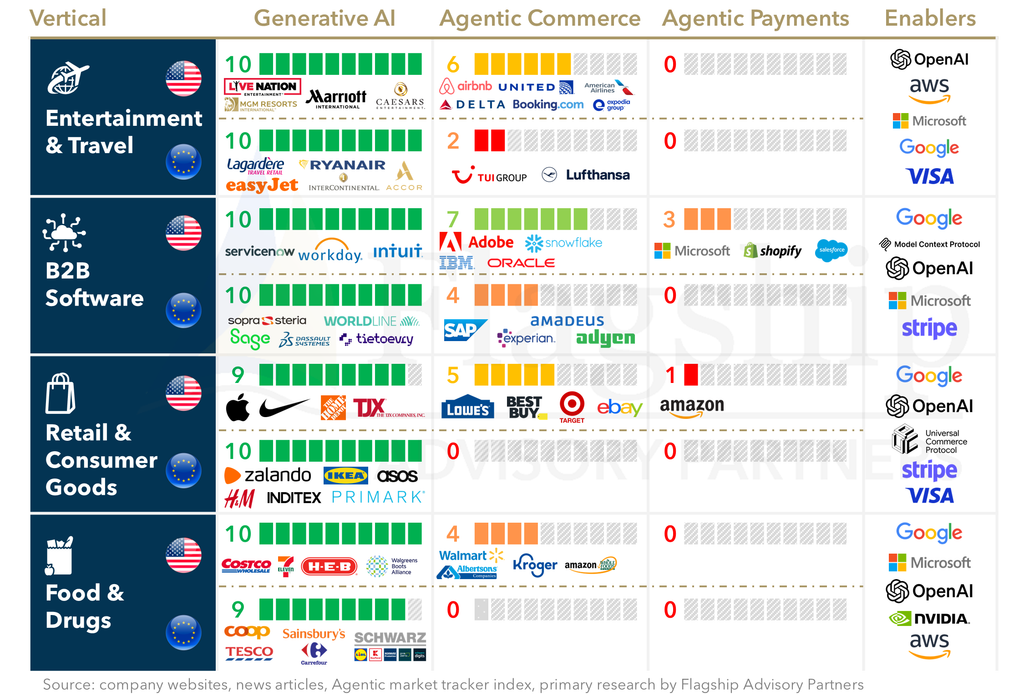
As a reminder, we classify observed deployments into three stages:
Generative AI: customer-facing AI that generates or summarizes content in response to a user prompt (Q&A bots, conversational product guidance, visual search).
Agentic Commerce: AI agents that orchestrate multi-step shopping tasks across the journey (discover, compare, plan, build cart or itinerary) but do not execute payment.
Agentic Payments: an AI agent initiates and completes checkout on the customer’s behalf using permissioned payment tokens, virtual cards, wallets, or other rails.
Key observations:
- B2B software is furthest along the AI ladder. Announcements from Snowflake and IBM pushed the number of US brands up to 7 of the top 10 supporting agentic commerce. Amadeus, Experian, and Adyen increased the EU count from 1 to 4. Software firms are moving fastest because they are both adopters and enablers of the agentic stack.
- Only 4 of 80 companies support agent-led checkout, all of whom are US based. Salesforce became the third US software provider to support agentic payments with its support for AP2 and ACP in what is now Agentforce Commerce (formerly Commerce Cloud).
- Consumer verticals have plateaued. No new US entertainment & travel, retail, or food & drugs brands have made announcements since January, and consumer brands in the EU still show little agentic commerce beyond GenAI.
2. Agentic Commerce Top Use-cases per Vertical
(customer-facing use cases Aug 2026, select companies, non-exhaustive)
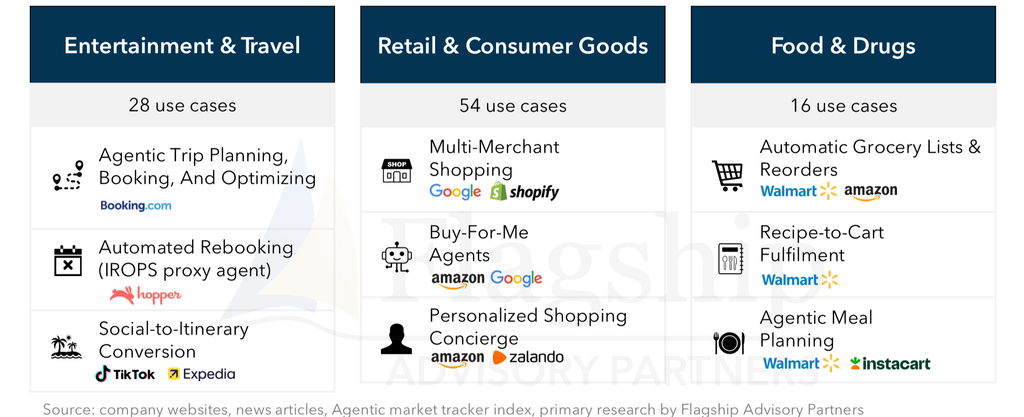
- Merchants that are rolling out agentic commerce use cases are showcasing what the future of shopping could look like. Walmart’s grocery use cases are especially interesting: their “Sparky” agent can now auto-reorders repeat items, build carts based on recipes, and help with meal planning. Walmart said items sold via Sparky are up 4x year-over-year.
- Amazon’s Buy for Me (piloted in April 2025) completes purchases from third-party brand sites inside the Amazon app, while Google’s Universal Shopping Cart can buy from merchants such as Wayfair, Chewy, and Shopify when a tracked price is hit.
3. AI-Driven Commerce, H1 2026
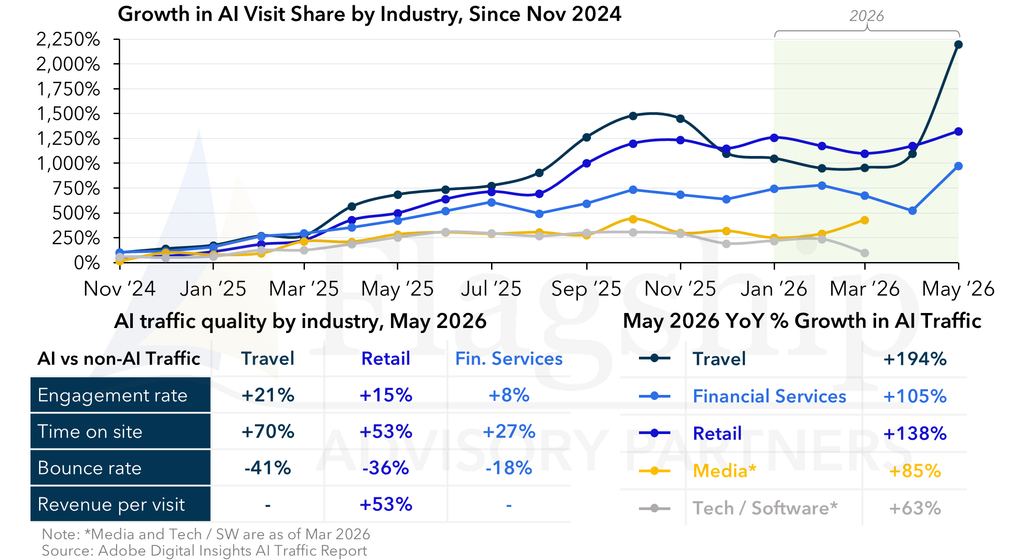
- AI traffic for Travel, Retail, and FIs hits new highs. AI traffic in travel skyrocketed during April and May, which we believe is an indication that people experimented with AI assistants while planning their summer trips. Travelers report using AI for research (48%), inspiration (44%), and budgeting (30%). Usage during the 2025 holiday season declined, which may indicate occasional shoppers don’t use AI as much or people just generally want to put more personal thought into gifts for others.
- AI-referred visitors are more engaged, stay longer, and bounce less than non-AI visitors in every vertical. For retail specifically, they generate 53% more revenue, a big shift from last year when AI-referred site visits were only worth half as much as visits from other sources.
- AI-driven traffic for retail and travel industries is up ~13x and ~20x, respectively, showing that consumer trust and comfort with AI are rising.
4. Plug-ins for OpenAI and Claude per Industry
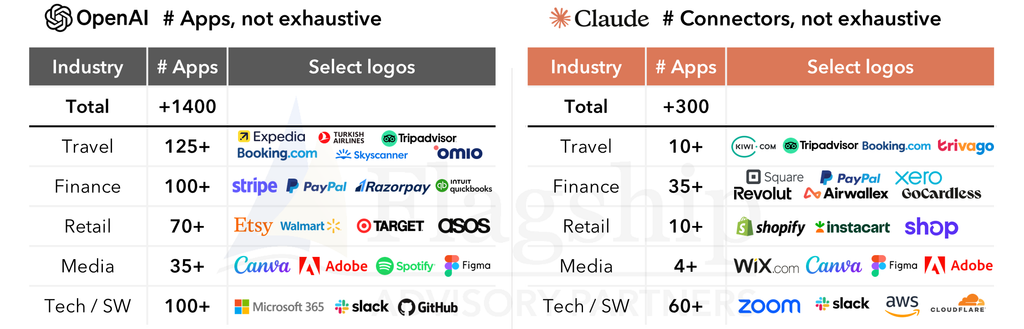
Source: Adobe Digital Insights, OpenAI, Anthropic, Flagship Advisory Partners
- Product discovery is increasingly starting inside LLM conversations using apps and connectors. We see Travel and Finance brands (the same verticals posting the strongest AI traffic growth) leading the way on building apps/connectors.
- Apps/connectors provide an integrated, personalized experience and make it more likely that customers will look to merchants they know for information because those apps/connectors make it easier for LLMs to access the right data. This all converts into more AI-referred website visits.
5) Agentic Barriers Across the Online Shopping Journey
(non-exhaustive)
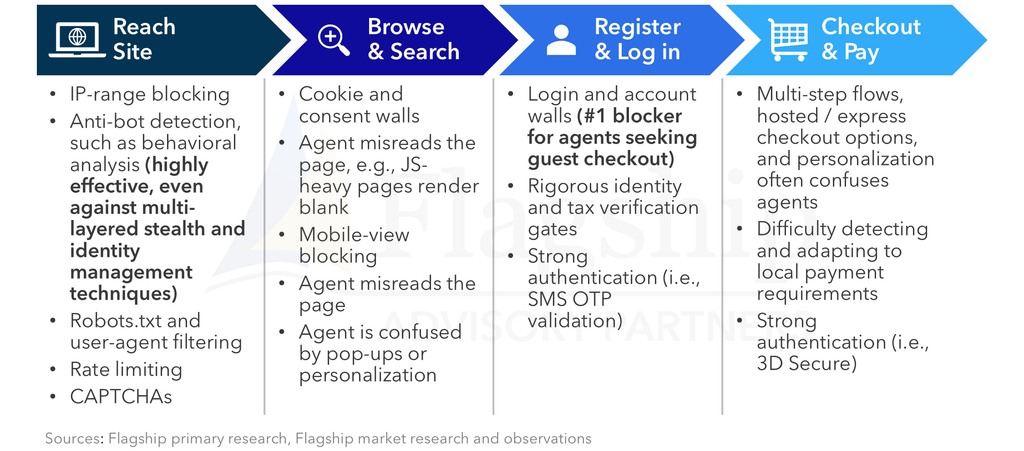
- eCommerce sites are set up with layered defenses against bots, implemented over the years when retailers could assume all bots are bad bots
- Merchants have been slow to tune their models or implement new infrastructure to allow good bots because of open commercial questions around liability, customer ownership, and behavior/performance
6) B2B Specific Barriers
(20 major B2B providers with headquarters in each market across different verticals, n=80)
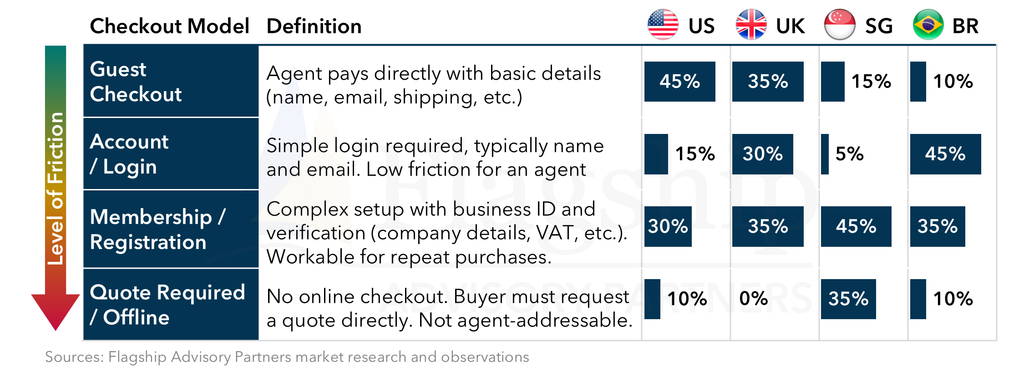
- Agentic payments have a strong value proposition in B2B, where efficiency is paramount and complex AP/AR processes sit just upstream of most payments. However, more than half of US B2B sales still take place offline, either in-person or through MO/TO and paper invoices. Our recent desk research found 90% of suppliers in a small sample had some sort of eCommerce site; a global survey of 4,000 B2B decision-makers by McKinsey found 71% of B2B companies have an eCommerce site.
- For the 45% of B2B sales that do occur online, almost half happen over EDI networks. General-purpose desktop and browser agents are likely to struggle to access and navigate those platforms.
- A recent scan by Flagship of 20 large B2B tools (ERP systems and cloud accounting platforms, spend management tools, and AR/AP automation platforms) found that almost everyone has built and shipped native AI agents or MCP servers, but almost none of them will let an agent move money. Ramp, Coupa, Melio, and BILL appear to be leading the way on B2B agentic payments.
Conclusion
In January, we forecasted that near-term progress is likely to focus on agent-assisted commerce (discovery, planning, automated cart/itinerary assembly, etc.) while agentic payments required more work to be done on trust, governance, and interoperability. The last six months have proved that to be true, though we are surprised by seeing zero movement among the top consumer brands for agentic payments.
Walmart’s quick withdrawal from ChatGPT Instant Checkout in March (they found it converted at only 1/3 the rate of normal website visits) caused some retailers to step back from active projects on agentic payments. Now, Adobe’s August data shows that AI-referred traffic is growing and converting better than traditional visits, and leading merchants are shipping agentic commerce use cases that have clear value for consumers.
We look forward to seeing how new data motivates behavior across sectors. In the next few months, we will be watching the B2B, travel, and food sectors closely for new agentic commerce and payment experiences.
Please do not hesitate to contact Ben Brown at Ben@FlagshipAP.com or Katharine Watson at Katharine@FlagshipAP.com with comments or questions.